Deep Learning · MT2 · section
Output size and parameter count are different
Convolutional neural networks
Definition. Output shape specifies the size of a layer's computed tensor. Parameter count specifies the number of independent trainable coefficients. Spatial weight sharing allows a convolutional layer to produce many activations from comparatively few parameters.
Explanation and working
Question. A 7 × 7 × 3 input passes through two 3 × 3 filters, stride 2 and padding 1. Find output shape and parameter count, including bias.
Given
Input = 7 × 7 × 3; two 3 × 3 filters.
Stride = 2; padding = 1; include biases.
To find
Find the output shape and trainable parameter count.
Formula — which one and why
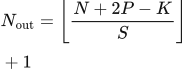
Convolution/pooling spatial size. Padding adds P positions at both ends. Subtract kernel width to find the last valid start, divide by stride, take the floor and include the initial placement with +1.
N = current height or width; K = kernel/window size; S = stride; P = padding per side. Apply separately to height and width; dilation is 1 here.
 LaTeX:
N_{\mathrm{out}}=\left\lfloor\frac{N+2P-K}{S}\right\rfloor+1Yaad rakhne ka cue: Input + dono sides ki padding − kernel; stride se divide; floor + 1.
Convolution parameters. Every filter spans all input channels. Count its spatial coefficients across those channels, add one bias and multiply by the number of filters.
K_h,K_w = filter height/width; C_in = input channels; C_out = number of filters and output channels. Spatial output positions reuse these weights.
 LaTeX:
N_w=K_hK_wC_{\mathrm{in}}C_{\mathrm{out}} LaTeX:
N_b=C_{\mathrm{out}} LaTeX:
P=N_w+N_bYaad rakhne ka cue: Filter area × input channels × filters; phir ek bias per filter.
Solution — step by step
Step 1 spatial size: padding adds two, giving 7 + 2 − 3 = 6. Divide by stride: 6 ÷ 2 = 3. Apply floor and add the first position: 3 + 1 = 4. There are two filters, so output is 4 × 4 × 2.
Step 2 parameters: one filter has 3 × 3 × 3 = 27 weights and one bias, giving 28. Two filters have 56 parameters. The 4 × 4 output positions reuse those weights; they do not create 16 new sets of parameters.