Deep Learning · MT2 · section
Stride padding and floor
Convolutional neural networks
Definition. Stride is the spacing between consecutive kernel positions. Padding extends the input boundary. Together with kernel size and dilation, they determine the spatial dimensions of a convolutional output.
Explanation and working
Stride is how far the filter moves each time. Stride 2 visits starting positions 0, 2, 4 and so on. Padding adds border values, usually zeros. Padding 1 means one new row or column on each side, adding 2 to a spatial dimension.
 LaTeX:
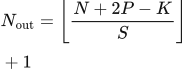
N_{\mathrm{out}}=\left\lfloor\frac{N+2P-K}{S}\right\rfloor+1N is input size; P is padding per side; K is kernel size; S is stride. Floor means take the greatest integer not above the result:  LaTeX:
\left\lfloor 2.5\right\rfloor = 2. It counts only positions where the entire window fits. The formula assumes dilation 1, the standard setting in these papers. Apply it separately to height and width for rectangular images or kernels.
Why plus one? Even when the kernel exactly fits the image, there is one placement. If N = K, P = 0, S = 1, the formula is 0 + 1 = 1.
Output dimension with a fractional intermediate result
Question. A convolution has input side N = 6, kernel side K = 3, stride S = 2 and padding P = 0. Find its output side.
Given
N = 6; K = 3; S = 2; P = 0; dilation = 1.
To find
The integer output side length.
Formula — which one and why
The formula counts complete kernel placements. Flooring removes an incomplete final placement.
N is input side; P is padding on each side; K is kernel side; S is stride.
LaTeX: N_{\mathrm{out}}=\left\lfloor\frac{N+2P-K}{S}\right\rfloor+1Yaad rakhne ka cue: Padding dono side; stride se divide; floor; phir +1.
Solution — step by step
Step 1: include padding and subtract kernel size.
 LaTeX:
6+2(0)-3=3Step 2: divide by the stride.
 LaTeX:
\frac32=1.5Step 3: take the floor.
 LaTeX:
\lfloor1.5\rfloor=1Step 4: count the first placement.
 LaTeX:
N_{\mathrm{out}}=1+1=2Final answer: Output side = 2; a square input gives a 2 × 2 map per filter.
Padding on both sides
Question. A square convolution input has side 5, kernel side 3, stride 1 and padding 1 on each side. Find the padded-input size and output size.
Given
N = 5; K = 3; S = 1; P = 1 on each side.
To find
Padded input and output dimensions.
Formula — which one and why
Padding adds P entries on each of two opposite sides; the output counts complete kernel placements.
N = unpadded side; K = kernel side; S = stride; P = per-side padding.
 LaTeX:
N_{\mathrm{padded}}=N+2P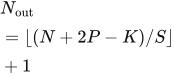 LaTeX:
N_{\mathrm{out}}=\lfloor(N+2P-K)/S\rfloor+1Yaad rakhne ka cue: Padded input aur output ka size alag cheez hain.
Solution — step by step
Step 1: count both padding edges.
 LaTeX:
2P=2(1)=2Step 2: calculate the padded input side.
 LaTeX:
N+2P=5+2=7Step 3: subtract kernel width.
 LaTeX:
7-3=4Step 4: divide by stride and take the floor.
 LaTeX:
\lfloor4/1\rfloor=4Step 5: include the first placement.
 LaTeX:
N_{out}=4+1=5Final answer: Padded input = 7 × 7; output = 5 × 5 per filter.
“Valid” usually means P = 0. For odd K and S = 1, padding (K − 1)/2 preserves the spatial size. For S greater than 1, software “same” padding can be asymmetric and commonly gives ceiling(N/S); do not force the stride-1 rule into that case.