Deep Learning · MT2 · section
Pooling needs comparisons or averages
Convolutional neural networks
Definition. Pooling is a local aggregation operation that summarizes each spatial window, usually independently per channel. Max pooling selects the largest value; average pooling calculates a mean. Standard pooling has no learned weights or biases.
Explanation and working
Max pooling selects the largest value inside each window. Average pooling adds window entries and divides by their count. Ordinary max and average pooling have no learned weights or biases. Pool each input channel independently, so the number of channels is unchanged.
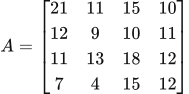
Question. Pool this 4 × 4 map with 2 × 2 windows, stride 2 and no padding:
Given
The 4 × 4 input map is printed below.
Window = 2 × 2; stride = 2; padding = 0.
To find
Find the pooled output by the operation(s) requested.
Formula — which one and why
Pooling. Max pooling selects the largest window entry. Average pooling adds its entries and divides by their count. Each channel is pooled separately.
V = current pooling window; n = number of entries in that window. Pooling learns no weights or biases.
 LaTeX:
y_{\max}=\max V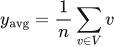 LaTeX:
y_{\mathrm{avg}}=\frac1n\sum_{v\in V}vYaad rakhne ka cue: Max mein biggest; average mein total ÷ window ka count.
Solution — step by step
 LaTeX:
A=\begin{bmatrix}21&11&15&10\\12&9&10&11\\11&13&18&12\\7&4&15&12\end{bmatrix}Top-left window
Step 1: select the four entries.
[21, 11, 12, 9]
Step 2: choose the largest entry.
 LaTeX:
y_{\max}=21Step 3: add all entries.
 LaTeX:
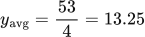
21+11+12+9=53Step 4: divide the sum by four for the average.
 LaTeX:
y_{\mathrm{avg}}=\frac{53}4=13.25Top-right window
Step 1: select the four entries.
[15, 10, 10, 11]
Step 2: choose the largest entry.
 LaTeX:
y_{\max}=15Step 3: add all entries.
 LaTeX:
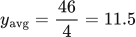
15+10+10+11=46Step 4: divide the sum by four for the average.
 LaTeX:
y_{\mathrm{avg}}=\frac{46}4=11.5Bottom-left window
Step 1: select the four entries.
[11, 13, 7, 4]
Step 2: choose the largest entry.
 LaTeX:
y_{\max}=13Step 3: add all entries.
 LaTeX:
11+13+7+4=35Step 4: divide the sum by four for the average.
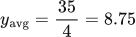 LaTeX:
y_{\mathrm{avg}}=\frac{35}4=8.75Bottom-right window
Step 1: select the four entries.
[18, 12, 15, 12]
Step 2: choose the largest entry.
 LaTeX:
y_{\max}=18Step 3: add all entries.
 LaTeX:
18+12+15+12=57Step 4: divide the sum by four for the average.
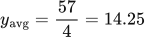 LaTeX:
y_{\mathrm{avg}}=\frac{57}4=14.25Outputs are max  LaTeX:
\begin{bmatrix}21 & 15\\13 & 18\end{bmatrix} and average 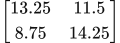 LaTeX:
\begin{bmatrix}13.25 & 11.5\\8.75 & 14.25\end{bmatrix}.
Pooling reduces spatial size and later computation and can provide limited robustness to small shifts. It can lose exact position information. It does not guarantee complete translation invariance.