Deep Learning · MT2 · section
Parameters are different from activation values
Convolutional neural networks
Definition. Parameters are learned coefficients shared across evaluations. Activations are input-dependent values computed during a forward pass. The number of activation values therefore differs from the number of trainable parameters.
Explanation and working
An activation is a number produced for a particular input. A parameter is a learned number reused across inputs. A 100 × 100 feature map can be produced by a filter with only a few weights.
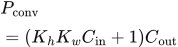 LaTeX:
P_{\mathrm{conv}}=(K_hK_wC_{\mathrm{in}}+1)C_{\mathrm{out}}The +1 is one bias per filter. If bias is explicitly disabled, remove it. Height and width of the image do not enter the parameter formula; they enter the number of output activations and the amount of computation.
One filter, then all filters
Question. A 3 × 3 convolution receives 3 input channels and has 16 filters, each with one bias. Find its trainable parameters and output-channel count.
Given
Kernel = 3 × 3; input channels = 3; filters = 16; one bias per filter.
To find
Weights, biases, total trainable parameters and output channels.
Formula — which one and why
Each filter spans every input channel and owns one bias. Spatial reuse does not create extra weights.
Kₕ,Kw are kernel dimensions; Cᵢₙ is input depth; Cₒᵤₜ is the number of filters.
 LaTeX:
P=(K_hK_wC_{\mathrm{in}}+1)C_{\mathrm{out}}Yaad rakhne ka cue: Ek filter ka count banao, phir filters se multiply.
Solution — step by step
Step 1: count weights in one filter.
 LaTeX:
3(3)(3)=27Step 2: include its one bias.
 LaTeX:
27+1=28Step 3: count all weights.
 LaTeX:
27(16)=432Step 4: count all biases.
 LaTeX:
1(16)=16Step 5: add and state channel count.
 LaTeX:
P=432+16=448Each filter produces one channel, so output channels = 16.
Final answer: 432 weights + 16 biases = 448 trainable parameters; 16 output channels.
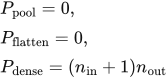 LaTeX:
P_{\mathrm{pool}}=0,\quad P_{\mathrm{flatten}}=0,\quad P_{\mathrm{dense}}=(n_{\mathrm{in}}+1)n_{\mathrm{out}}Flatten rearranges H × W × C activation values into one vector of length HWC. It does not learn anything. A following dense layer connects to every one of those values.