Deep Learning · MT2 · section
One complete CNN pipeline
Convolutional neural networks
Question. Input 128 × 128 × 3 → convolution 3 × 3, 16 filters, stride 1, no padding → pooling 2 × 2, stride 2 → convolution 3 × 3, 32 filters, stride 1, no padding → pooling 2 × 2, stride 2 → dense 240 → dense 120 → dense 5 with softmax. Find every output shape and trainable parameter count. Assume one bias per receiving filter or dense neuron.
Given
Input = 128 × 128 × 3.
Conv: 3 × 3,16 filters,stride 1,valid → pool 2,stride 2.
Conv: 3 × 3,32 filters,stride 1,valid → pool 2,stride 2.
Flatten → dense 240 → dense 120 → dense 5.
One bias per learned filter/dense neuron.
To find
Find every output shape and layer parameter count, then the network total.
Formula — which one and why
Complete CNN calculation. Carry each output shape into the next layer. Convolution changes spatial size and channel count; pooling changes spatial size; flattening converts all activations into dense-layer inputs.
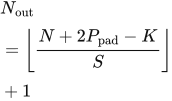
H,W,C = feature-map height, width and channels; K = kernel size; S = stride; P_pad = padding. One bias is assumed for each learned filter or dense neuron unless specified otherwise.
 LaTeX:
N_{\mathrm{out}}=\left\lfloor\frac{N+2P_{\mathrm{pad}}-K}{S}\right\rfloor+1 LaTeX:
P_{\mathrm{conv}}=(K^2C_{\mathrm{in}}+1)C_{\mathrm{out}} LaTeX:
n_{\mathrm{flat}}=HWC LaTeX:
P_{\mathrm{dense}}=(n_{\mathrm{in}}+1)n_{\mathrm{out}} LaTeX:
P_{\mathrm{pool}}=P_{\mathrm{flatten}}=0Yaad rakhne ka cue: Ek layer ka output, next layer ka input; shape aur parameters alag count.
Solution — step by step
Step 1. Conv 1 size. (128 − 3)/1 + 1 = 126; output 126 × 126 × 16. Parameters = (3 × 3 × 3 + 1) × 16 = 448.
Step 2. Pool 1 size. 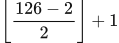 LaTeX:
\left\lfloor\frac{126 - 2}{2}\right\rfloor+1 = 63; output 63 × 63 × 16. Parameters = 0.
Step 3. Conv 2 size. (63 − 3)/1 + 1 = 61; output 61 × 61 × 32. Input channels are now 16, not the original 3. Parameters = (3 × 3 × 16 + 1) × 32 = 4,640.
Step 4. Pool 2 size. 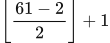 LaTeX:
\left\lfloor\frac{61 - 2}{2}\right\rfloor+1 =  LaTeX:
\left\lfloor 29.5\right\rfloor + 1 = 30; output 30 × 30 × 32. Parameters = 0.
Step 5. Flatten. 30 × 30 × 32 = 28,800 values. Parameters = 0.
Step 6. Dense 240. 28,800 weights per neuron plus one bias, multiplied by 240: (28,800 + 1) × 240 = 6,912,240.
Step 7. Dense 120. (240 + 1) × 120 = 28,920.
Step 8. Classifier. (120 + 1) × 5 = 605. Softmax itself adds no extra parameters; these 605 belong to the dense class-score layer.
Step 9. Total. 448 + 4,640 + 6,912,240 + 28,920 + 605 = 6,946,853. Most parameters come from the first dense layer.