Deep Learning · TEE · formulas
ReLU and its derivative
ReLU compares its input with zero and keeps the larger value. Thus a negative input becomes zero and a positive input passes unchanged. Its slope is zero on the negative side and one on the positive side.
 LaTeX:
f(z)=\max(0,z)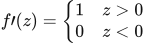 LaTeX:
f\prime(z)=\begin{cases}1&z>0\\0&z<0\end{cases}Drill 8 Activation contrast
Question
Question. For z = [−3,0,2], find ReLU and Leaky ReLU with α = 0.1, and the sigmoid derivative at z = 0.
Answer — step by step
Given
Inputs z = [−3,0,2].
Leaky-ReLU negative slope α = 0.1.
For the sigmoid derivative, use z = 0.
To find
Find ReLU and Leaky-ReLU outputs and the sigmoid slope at zero.
Formula — which one and why
ReLU and Leaky ReLU. ReLU returns zero for negative input and retains positive input. Leaky ReLU instead multiplies a negative input by its supplied slope.
z = preactivation; α (alpha) = supplied negative-side slope for Leaky ReLU. The derivative at zero needs an explicit convention.
 LaTeX:
\operatorname{ReLU}(z)=\max(0,z) LaTeX:
\operatorname{LeakyReLU}(z)=\begin{cases}z&z\ge0\\\alpha z&z<0\end{cases}Yaad rakhne ka cue: Positive ko rehne do; negative ko zero. Leaky mein chhota negative rehne do.
Sigmoid and its slope. Use sigmoid when the neuron is specified to squash its preactivation into (0,1). Once its output is known, its derivative needs only output × (1−output).
z = preactivation; p = sigmoid output; e is the exponential base, not a prediction error in this formula.
 LaTeX:
p=\frac{1}{1+e^{-z}}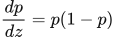 LaTeX:
\frac{dp}{dz}=p(1-p)Yaad rakhne ka cue: Sigmoid output p; uska slope p × (1−p).
Solution — step by step
Formulas and their meanings
ReLU compares the input with zero and returns the larger value.
LaTeX: \operatorname{ReLU}(z)=\max(0,z)Leaky ReLU uses the input unchanged when nonnegative, and multiplies it by α when negative.
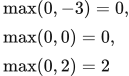
LaTeX: \operatorname{LeakyReLU}(z)=\begin{cases}z&z\ge0\\\alpha z&z<0\end{cases}Step 1: apply ReLU separately to all three inputs
 LaTeX:
\max(0,-3)=0,\quad \max(0,0)=0,\quad \max(0,2)=2ReLU output = [0, 0, 2].
Step 2: use α = 0.1 only on the negative input
 LaTeX:
0.1\times(-3)=-0.3The zero and positive entries remain 0 and 2. Leaky ReLU output = [−0.3, 0, 2].
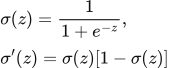
Step 3: calculate sigmoid before its derivative
 LaTeX:
\sigma(z)=\frac1{1+e^{-z}},\qquad \sigma'(z)=\sigma(z)[1-\sigma(z)]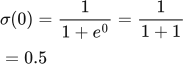 LaTeX:
\sigma(0)=\frac1{1+e^0}=\frac1{1+1}=0.5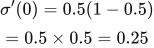 LaTeX:
\sigma'(0)=0.5(1-0.5)=0.5\times0.5=0.25The sigmoid value is 0.5 but its slope is 0.25. They are different quantities.
ReLU example 1
Question. For preactivation z = -2, calculate the ReLU output and state its derivative.
Given
z = -2; activation = ReLU.
To find
The output a and the derivative with respect to z.
Formula — which one and why
Use the activation named in the question. The derivative is a second calculation required for a backward pass.
z is the raw sum; a is the activated output; f′(z) is the local slope.
 LaTeX:
a=\max(0,z)Yaad rakhne ka cue: Positive side slope 1; negative side ReLU 0, Leaky α. Zero par convention likho.
Solution — step by step
Step 1: select the branch from the sign of z.
-2 is negative, so use the negative branch.
Step 2: calculate the output.
 LaTeX:
a=0Step 3: state the slope on that branch.
 LaTeX:
f\prime(-2)=0Final answer: a ≈ 0.000000000. Derivative ≈ 0.000000000.
ReLU example 2
Question. For preactivation z = 0, calculate the ReLU output and state its derivative.
Given
z = 0; activation = ReLU.
To find
The output a and the derivative with respect to z.
Formula — which one and why
Use the activation named in the question. The derivative is a second calculation required for a backward pass.
z is the raw sum; a is the activated output; f′(z) is the local slope.
LaTeX: a=\max(0,z)Yaad rakhne ka cue: Positive side slope 1; negative side ReLU 0, Leaky α. Zero par convention likho.
Solution — step by step
Step 1: select the branch from the sign of z.
Both branches meet at zero. The value is zero, but the left and right slopes differ.
Step 2: calculate the output.
LaTeX: a=0Step 3: state the slope on that branch.
The ordinary derivative at zero does not exist. A software subgradient convention may choose a value such as 0; state it if required.
Final answer: a ≈ 0.000000000. Ordinary derivative is undefined at zero.
ReLU example 3
Question. For preactivation z = 2, calculate the ReLU output and state its derivative.
Given
z = 2; activation = ReLU.
To find
The output a and the derivative with respect to z.
Formula — which one and why
Use the activation named in the question. The derivative is a second calculation required for a backward pass.
z is the raw sum; a is the activated output; f′(z) is the local slope.
LaTeX: a=\max(0,z)Yaad rakhne ka cue: Positive side slope 1; negative side ReLU 0, Leaky α. Zero par convention likho.
Solution — step by step
Step 1: select the branch from the sign of z.
2 is positive, so retain it.
Step 2: calculate the output.
 LaTeX:
a=2Step 3: state the slope on that branch.
 LaTeX:
f\prime(2)=1Final answer: a ≈ 2.000000000. Derivative ≈ 1.000000000.