Deep Learning · TEE · formulas
Max, min and average pooling
Pooling reduces each window to one value. Max pooling keeps the largest entry; average pooling adds all included entries and divides by their count. Pooling is performed independently in each channel.
 LaTeX:
y_{\min}=\min(x_1,x_2,x_3,x_4)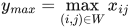 LaTeX:
y_{max}=\max_{(i,j)\in W}x_{ij}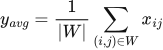 LaTeX:
y_{avg}=\frac1{|W|}\sum_{(i,j)\in W}x_{ij}Pooling needs comparisons or averages
Definition. Pooling is a local aggregation operation that summarizes each spatial window, usually independently per channel. Max pooling selects the largest value; average pooling calculates a mean. Standard pooling has no learned weights or biases.
Explanation and working
Max pooling selects the largest value inside each window. Average pooling adds window entries and divides by their count. Ordinary max and average pooling have no learned weights or biases. Pool each input channel independently, so the number of channels is unchanged.
Question. Pool this 4 × 4 map with 2 × 2 windows, stride 2 and no padding:
Given
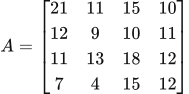
The 4 × 4 input map is printed below.
Window = 2 × 2; stride = 2; padding = 0.
To find
Find the pooled output by the operation(s) requested.
Formula — which one and why
Pooling. Max pooling selects the largest window entry. Average pooling adds its entries and divides by their count. Each channel is pooled separately.
V = current pooling window; n = number of entries in that window. Pooling learns no weights or biases.
 LaTeX:
y_{\max}=\max V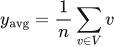 LaTeX:
y_{\mathrm{avg}}=\frac1n\sum_{v\in V}vYaad rakhne ka cue: Max mein biggest; average mein total ÷ window ka count.
Solution — step by step
 LaTeX:
A=\begin{bmatrix}21&11&15&10\\12&9&10&11\\11&13&18&12\\7&4&15&12\end{bmatrix}Top-left window
Step 1: select the four entries.
[21, 11, 12, 9]
Step 2: choose the largest entry.
 LaTeX:
y_{\max}=21Step 3: add all entries.
 LaTeX:
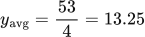
21+11+12+9=53Step 4: divide the sum by four for the average.
 LaTeX:
y_{\mathrm{avg}}=\frac{53}4=13.25Top-right window
Step 1: select the four entries.
[15, 10, 10, 11]
Step 2: choose the largest entry.
 LaTeX:
y_{\max}=15Step 3: add all entries.
 LaTeX:
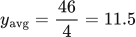
15+10+10+11=46Step 4: divide the sum by four for the average.
 LaTeX:
y_{\mathrm{avg}}=\frac{46}4=11.5Bottom-left window
Step 1: select the four entries.
[11, 13, 7, 4]
Step 2: choose the largest entry.
 LaTeX:
y_{\max}=13Step 3: add all entries.
 LaTeX:
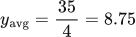
11+13+7+4=35Step 4: divide the sum by four for the average.
 LaTeX:
y_{\mathrm{avg}}=\frac{35}4=8.75Bottom-right window
Step 1: select the four entries.
[18, 12, 15, 12]
Step 2: choose the largest entry.
 LaTeX:
y_{\max}=18Step 3: add all entries.
 LaTeX:
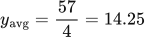
18+12+15+12=57Step 4: divide the sum by four for the average.
 LaTeX:
y_{\mathrm{avg}}=\frac{57}4=14.25Outputs are max  LaTeX:
\begin{bmatrix}21 & 15\\13 & 18\end{bmatrix} and average 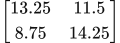 LaTeX:
\begin{bmatrix}13.25 & 11.5\\8.75 & 14.25\end{bmatrix}.
Pooling reduces spatial size and later computation and can provide limited robustness to small shifts. It can lose exact position information. It does not guarantee complete translation invariance.
Max, min and average pooling on the same lecture grid
Definition. Pooling summarizes each local window separately within each channel. Max pooling keeps its largest value, min pooling its smallest value, and average pooling its arithmetic mean. Ordinary versions have no trainable weights or biases.
Question. Apply 2 × 2 max, min and average pooling with stride 2 and no padding to the following 4 × 4 input. Give all three output matrices. (Practice: 3 marks)
Given
X = 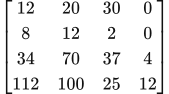 LaTeX:
\begin{bmatrix}12 & 20 & 30 & 0\\8 & 12 & 2 & 0\\34 & 70 & 37 & 4\\112 & 100 & 25 & 12\end{bmatrix}. Window = 2 × 2; stride = 2; padding = 0.
To find
The shared output shape and each of the four cells for each pooling method.
Formula — which one and why
Each output summarizes four input numbers. Use max for the largest, min for the smallest, and sum divided by 4 for the average. The window moves two cells, so these four windows do not overlap.
 LaTeX:
y_{\max}=\max(x_1,x_2,x_3,x_4)LaTeX: y_{\min}=\min(x_1,x_2,x_3,x_4) LaTeX:
y_{\mathrm{avg}}=\frac{x_1+x_2+x_3+x_4}{4}Solution — step by step
Step 1: output size. (4 −2)/2 +1 = 2. Each output has shape 2 × 2.
Step 2: top-left window [12,20,8,12]. Largest = 20; smallest = 8. Sum = 12+20+8+12 = 52. Average = 52/4 = 13.
Step 3: top-right window [30,0,2,0]. Largest = 30; smallest = 0. Sum = 30+0+2+0 = 32. Average = 32/4 = 8.
Step 4: bottom-left window [34,70,112,100]. Largest = 112; smallest = 34. Sum = 34+70+112+100 = 316. Average = 316/4 = 79.
Step 5: bottom-right window [37,4,25,12]. Largest = 37; smallest = 4. Sum = 37+4+25+12 = 78. Average = 78/4 = 19.5. Do not silently round this to 20.
Step 6: put each result back in its window's position. Max =  LaTeX:
\begin{bmatrix}20 & 30\\112 & 37\end{bmatrix}. Min =  LaTeX:
\begin{bmatrix}8 & 0\\34 & 4\end{bmatrix}. Average =  LaTeX:
\begin{bmatrix}13 & 8\\79 & 19.5\end{bmatrix}.
Final answer: Three 2 × 2 maps as above; zero trainable parameters for each pooling operation.
Why the choice matters
Max retains the largest activation in a feature window, which can still be negative if every entry is negative. Min retains the lowest response. Average retains an overall response but can dilute a sharp local peak. On raw intensity images, min can retain a dark stroke and max can retain a bright stroke. A learned CNN feature map represents filter responses; the best pooling choice is not determined solely by the original background colour.
Pooling has no parameters to update, but gradients can still pass through it. For a unique max, the upstream gradient is routed to the winning input. For an average over four inputs, each receives one-fourth of that gradient. Fewer pooled activations can reduce a later dense layer's parameter count; they do not change the size of an earlier convolution's filter.
Yaad rakho: Max = sabse bada; min = sabse chhota; average = sab jodo, count se divide.
Drill 36 Max and average pooling
Question
Question. Pool the input A shown below with 2 × 2 windows and stride 2. Find max and average outputs.
Answer — step by step
Given
Input A is printed with the question.
Window size = 2 × 2; stride = 2; no padding.
To find
Find the complete max-pooling and average-pooling outputs.
Formula — which one and why
Pooling. Max pooling selects the largest window entry. Average pooling adds its entries and divides by their count. Each channel is pooled separately.
V = current pooling window; n = number of entries in that window. Pooling learns no weights or biases.
LaTeX: y_{\max}=\max VLaTeX: y_{\mathrm{avg}}=\frac1n\sum_{v\in V}vYaad rakhne ka cue: Max mein biggest; average mein total ÷ window ka count.
Solution — step by step
Formulas and meaning
Each 2 × 2 window contains four numbers. Max pooling selects the largest of those four. Average pooling adds all four and divides by 4. Move the window by the given stride after producing one answer.
 LaTeX:
p_{\mathrm{max}}=\max(a_1,a_2,a_3,a_4) LaTeX:
p_{\mathrm{avg}}=\frac{a_1+a_2+a_3+a_4}{4}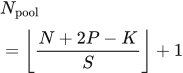 LaTeX:
N_{\mathrm{pool}}=\left\lfloor\frac{N+2P-K}{S}\right\rfloor+1Use the input size at the pooling layer. The output keeps the same channel count.
Shape: 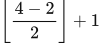 LaTeX:
\left\lfloor\frac{4-2}{2}\right\rfloor+1 = 2 on each axis; channels stay unchanged.
Pooling window (1,1)
Step 1: select the entries.
[1, 4, 0, 2]
Step 2: add all selected entries.
1 + 4 + 0 + 2 = 7
Step 3: divide by the 4 entries in this window.
7/4 = 1.75. Maximum = 4
Pooling window (1,2)
Step 1: select the entries.
[2, 3, 5, 1]
Step 2: add all selected entries.
2 + 3 + 5 + 1 = 11
Step 3: divide by the 4 entries in this window.
11/4 = 2.75. Maximum = 5
Pooling window (2,1)
Step 1: select the entries.
[6, 3, 1, 7]
Step 2: add all selected entries.
6 + 3 + 1 + 7 = 17
Step 3: divide by the 4 entries in this window.
17/4 = 4.25. Maximum = 7
Pooling window (2,2)
Step 1: select the entries.
[2, 0, 4, 8]
Step 2: add all selected entries.
2 + 0 + 4 + 8 = 14
Step 3: divide by the 4 entries in this window.
14/4 = 3.5. Maximum = 8
Average output: 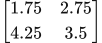 LaTeX:
\begin{bmatrix}1.75 & 2.75\\4.25 & 3.5\end{bmatrix}. Max output:  LaTeX:
\begin{bmatrix}4 & 5\\7 & 8\end{bmatrix}. Pooling normally has zero trainable parameters and reduces spatial dimensions.
Drill 46 Mixed convolution pool dense and loss
Question
Question. A is shown below, kernel Matrix 2 shown below, stride 1, valid. Apply ReLU, then 2 × 2 max pool stride 1. Flatten rowwise, use weight vector [0.1,0.2,0.3,0.4], bias 0, sigmoid output, target 1. Find all stages and BCE.
| 1 | 2 | 0 | 1 |
| 0 | 1 | 3 | 2 |
| 2 | 1 | 0 | 1 |
| 1 | 0 | 2 | 3 |
| 1 | 0 |
| 0 | −1 |
Stride 1; P = 0 (no padding).
Answer — step by step
Given
Input A and kernel Matrix 2 are printed with the question.
Conv: stride 1, valid padding; follow with ReLU.
Max pool: 2 × 2, stride 1; flatten row by row.
Dense weights = [0.1,0.2,0.3,0.4]; bias = 0; sigmoid output.
Binary target = 1.
To find
Find convolution, activated map, pooled map, flattened values, prediction and BCE.
Formula — which one and why
Convolution values. At each valid location, multiply corresponding window and kernel entries, add all products and add the filter bias once. Move by the stated stride and repeat.
X = input; K = kernel; S = stride; b = filter bias; u,v locate a kernel entry. Use the printed kernel without flipping under the stated deep-learning convention.
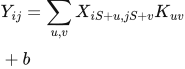 LaTeX:
Y_{ij}=\sum_{u,v}X_{iS+u,jS+v}K_{uv}+bYaad rakhne ka cue: Matching cells multiply; sab products add; bias sirf ek baar.
Pooling. Max pooling selects the largest window entry. Average pooling adds its entries and divides by their count. Each channel is pooled separately.
V = current pooling window; n = number of entries in that window. Pooling learns no weights or biases.
LaTeX: y_{\max}=\max VLaTeX: y_{\mathrm{avg}}=\frac1n\sum_{v\in V}vYaad rakhne ka cue: Max mein biggest; average mein total ÷ window ka count.
Weighted sum and activation. Each input is multiplied by its connection weight. Add these contributions, add the bias once, then apply the stated activation.
xᵢ = input i; wᵢ = its weight; b = bias; z = sum before activation; a = output after activation; f = the specified activation function.
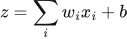 LaTeX:
z=\sum_iw_ix_i+b LaTeX:
a=f(z)Yaad rakhne ka cue: Input × weight, sabka sum, bias once, phir activation.
Sigmoid and its slope. Use sigmoid when the neuron is specified to squash its preactivation into (0,1). Once its output is known, its derivative needs only output × (1−output).
z = preactivation; p = sigmoid output; e is the exponential base, not a prediction error in this formula.
 LaTeX:
p=\frac{1}{1+e^{-z}}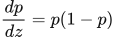 LaTeX:
\frac{dp}{dz}=p(1-p)Yaad rakhne ka cue: Sigmoid output p; uska slope p × (1−p).
Binary cross-entropy. For a binary target, choose the probability of the correct outcome and take its negative natural log. Sigmoid plus BCE has combined logit derivative p−y.
y is 0 or 1; p is the predicted probability of class 1; z is the sigmoid logit. The p−y derivative already includes the sigmoid derivative.
 LaTeX:
L=-[y\ln p+(1-y)\ln(1-p)] LaTeX:
\frac{\partial L}{\partial z}=p-yYaad rakhne ka cue: Binary target 1 ho toh −ln(p); target 0 ho toh −ln(1−p).
Solution — step by step
Formulas and the operation we are performing
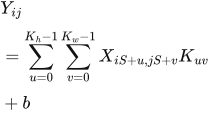
A filter window produces one output value. Multiply entries at matching positions and add the products. In this deep-learning convention, keep the filter in its printed orientation.
 LaTeX:
Y_{ij}=\sum_{u=0}^{K_h-1}\sum_{v=0}^{K_w-1}X_{iS+u,jS+v}K_{uv}+bHere i and j identify an output position; u and v count positions inside its window. S is stride, and b is the filter bias, zero in this question. The equation uses a padded input if padding is present and zero-based indices; the working below labels output positions from 1 for readability.
 LaTeX:
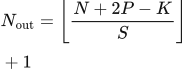
N_{\mathrm{out}}=\left\lfloor\frac{N+2P-K}{S}\right\rfloor+1N is input width/height, P is padding per side, and K is filter width/height. Floor means take the integer below the result, then add one.
Formulas and meaning
Each 2 × 2 window contains four numbers. Max pooling selects the largest of those four. Average pooling adds all four and divides by 4. Move the window by the given stride after producing one answer.
LaTeX: p_{\mathrm{max}}=\max(a_1,a_2,a_3,a_4)LaTeX: p_{\mathrm{avg}}=\frac{a_1+a_2+a_3+a_4}{4}LaTeX: N_{\mathrm{pool}}=\left\lfloor\frac{N+2P-K}{S}\right\rfloor+1Use the input size at the pooling layer. The output keeps the same channel count.
Completing the network after pooling
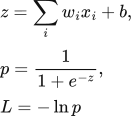
Flatten row by row. Multiply the resulting entries by the dense weights and add bias. Apply sigmoid to produce p. For target 1, binary cross-entropy is minus ln(p).
 LaTeX:
z=\sum_iw_ix_i+b,\qquad p=\frac1{1+e^{-z}},\qquad L=-\ln pFollow each selected input window below. Matching row colors connect its input cells, kernel coefficients and products; the outlined output cell shows where their sum belongs.
Step 1 shape: 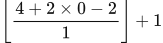 LaTeX:
\left\lfloor\frac{4+2 \times 0-2}{1}\right\rfloor+1 = 3 along each axis. Use the deep-learning cross-correlation convention: do not flip the printed kernel.
Output position (1, 1)
Use this position's input window. Multiply corresponding entries row by row; then add all row totals.
Input rows 1–2, columns 1–2. The window moves 1 cell per output step.
| 1 | 2 | 0 | 1 |
| 0 | 1 | 3 | 2 |
| 2 | 1 | 0 | 1 |
| 1 | 0 | 2 | 3 |
Only the outlined cells belong to this output.
| 1 | 0 |
| 0 | −1 |
Same row and column positions; no matrix multiplication.
| 1 | 0 |
| 0 | −1 |
Each cell is input × matching kernel coefficient.
1 + (−1) = 0
| 0 | −1 | −2 |
| −1 | 1 | 2 |
| 2 | −1 | −3 |
Output row 1, column 1.
Window row 1.
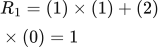 LaTeX:
R_1=(1)\times(1)+(2)\times(0)=1Window row 2.
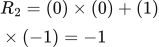 LaTeX:
R_2=(0)\times(0)+(1)\times(-1)=-1Add the rows to obtain one output cell.
 LaTeX:
Y_{1,1}=(1)+(-1)=0Output position (1, 2)
Use this position's input window. Multiply corresponding entries row by row; then add all row totals.
Input rows 1–2, columns 2–3. The window moves 1 cell per output step.
| 1 | 2 | 0 | 1 |
| 0 | 1 | 3 | 2 |
| 2 | 1 | 0 | 1 |
| 1 | 0 | 2 | 3 |
Only the outlined cells belong to this output.
| 1 | 0 |
| 0 | −1 |
Same row and column positions; no matrix multiplication.
| 2 | 0 |
| 0 | −3 |
Each cell is input × matching kernel coefficient.
2 + (−3) = −1
| 0 | −1 | −2 |
| −1 | 1 | 2 |
| 2 | −1 | −3 |
Output row 1, column 2.
Window row 1.
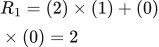 LaTeX:
R_1=(2)\times(1)+(0)\times(0)=2Window row 2.
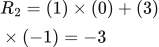 LaTeX:
R_2=(1)\times(0)+(3)\times(-1)=-3Add the rows to obtain one output cell.
 LaTeX:
Y_{1,2}=(2)+(-3)=-1Output position (1, 3)
Use this position's input window. Multiply corresponding entries row by row; then add all row totals.
Input rows 1–2, columns 3–4. The window moves 1 cell per output step.
| 1 | 2 | 0 | 1 |
| 0 | 1 | 3 | 2 |
| 2 | 1 | 0 | 1 |
| 1 | 0 | 2 | 3 |
Only the outlined cells belong to this output.
| 1 | 0 |
| 0 | −1 |
Same row and column positions; no matrix multiplication.
| 0 | 0 |
| 0 | −2 |
Each cell is input × matching kernel coefficient.
0 + (−2) = −2
| 0 | −1 | −2 |
| −1 | 1 | 2 |
| 2 | −1 | −3 |
Output row 1, column 3.
Window row 1.
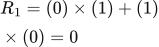 LaTeX:
R_1=(0)\times(1)+(1)\times(0)=0Window row 2.
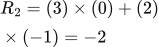 LaTeX:
R_2=(3)\times(0)+(2)\times(-1)=-2Add the rows to obtain one output cell.
 LaTeX:
Y_{1,3}=(0)+(-2)=-2Output position (2, 1)
Use this position's input window. Multiply corresponding entries row by row; then add all row totals.
Input rows 2–3, columns 1–2. The window moves 1 cell per output step.
| 1 | 2 | 0 | 1 |
| 0 | 1 | 3 | 2 |
| 2 | 1 | 0 | 1 |
| 1 | 0 | 2 | 3 |
Only the outlined cells belong to this output.
| 1 | 0 |
| 0 | −1 |
Same row and column positions; no matrix multiplication.
| 0 | 0 |
| 0 | −1 |
Each cell is input × matching kernel coefficient.
0 + (−1) = −1
| 0 | −1 | −2 |
| −1 | 1 | 2 |
| 2 | −1 | −3 |
Output row 2, column 1.
Window row 1.
LaTeX: R_1=(0)\times(1)+(1)\times(0)=0Window row 2.
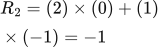 LaTeX:
R_2=(2)\times(0)+(1)\times(-1)=-1Add the rows to obtain one output cell.
 LaTeX:
Y_{2,1}=(0)+(-1)=-1Output position (2, 2)
Use this position's input window. Multiply corresponding entries row by row; then add all row totals.
Input rows 2–3, columns 2–3. The window moves 1 cell per output step.
| 1 | 2 | 0 | 1 |
| 0 | 1 | 3 | 2 |
| 2 | 1 | 0 | 1 |
| 1 | 0 | 2 | 3 |
Only the outlined cells belong to this output.
| 1 | 0 |
| 0 | −1 |
Same row and column positions; no matrix multiplication.
| 1 | 0 |
| 0 | 0 |
Each cell is input × matching kernel coefficient.
1 + 0 = 1
| 0 | −1 | −2 |
| −1 | 1 | 2 |
| 2 | −1 | −3 |
Output row 2, column 2.
Window row 1.
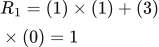 LaTeX:
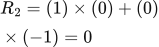
R_1=(1)\times(1)+(3)\times(0)=1Window row 2.
 LaTeX:
R_2=(1)\times(0)+(0)\times(-1)=0Add the rows to obtain one output cell.
 LaTeX:
Y_{2,2}=(1)+(0)=1Output position (2, 3)
Use this position's input window. Multiply corresponding entries row by row; then add all row totals.
Input rows 2–3, columns 3–4. The window moves 1 cell per output step.
| 1 | 2 | 0 | 1 |
| 0 | 1 | 3 | 2 |
| 2 | 1 | 0 | 1 |
| 1 | 0 | 2 | 3 |
Only the outlined cells belong to this output.
| 1 | 0 |
| 0 | −1 |
Same row and column positions; no matrix multiplication.
| 3 | 0 |
| 0 | −1 |
Each cell is input × matching kernel coefficient.
3 + (−1) = 2
| 0 | −1 | −2 |
| −1 | 1 | 2 |
| 2 | −1 | −3 |
Output row 2, column 3.
Window row 1.
 LaTeX:
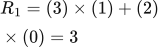
R_1=(3)\times(1)+(2)\times(0)=3Window row 2.
LaTeX: R_2=(0)\times(0)+(1)\times(-1)=-1Add the rows to obtain one output cell.
 LaTeX:
Y_{2,3}=(3)+(-1)=2Output position (3, 1)
Use this position's input window. Multiply corresponding entries row by row; then add all row totals.
Input rows 3–4, columns 1–2. The window moves 1 cell per output step.
| 1 | 2 | 0 | 1 |
| 0 | 1 | 3 | 2 |
| 2 | 1 | 0 | 1 |
| 1 | 0 | 2 | 3 |
Only the outlined cells belong to this output.
| 1 | 0 |
| 0 | −1 |
Same row and column positions; no matrix multiplication.
| 2 | 0 |
| 0 | 0 |
Each cell is input × matching kernel coefficient.
2 + 0 = 2
| 0 | −1 | −2 |
| −1 | 1 | 2 |
| 2 | −1 | −3 |
Output row 3, column 1.
Window row 1.
 LaTeX:
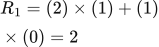
R_1=(2)\times(1)+(1)\times(0)=2Window row 2.
LaTeX: R_2=(1)\times(0)+(0)\times(-1)=0Add the rows to obtain one output cell.
 LaTeX:
Y_{3,1}=(2)+(0)=2Output position (3, 2)
Use this position's input window. Multiply corresponding entries row by row; then add all row totals.
Input rows 3–4, columns 2–3. The window moves 1 cell per output step.
| 1 | 2 | 0 | 1 |
| 0 | 1 | 3 | 2 |
| 2 | 1 | 0 | 1 |
| 1 | 0 | 2 | 3 |
Only the outlined cells belong to this output.
| 1 | 0 |
| 0 | −1 |
Same row and column positions; no matrix multiplication.
| 1 | 0 |
| 0 | −2 |
Each cell is input × matching kernel coefficient.
1 + (−2) = −1
| 0 | −1 | −2 |
| −1 | 1 | 2 |
| 2 | −1 | −3 |
Output row 3, column 2.
Window row 1.
 LaTeX:
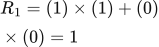
R_1=(1)\times(1)+(0)\times(0)=1Window row 2.
 LaTeX:
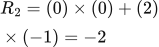
R_2=(0)\times(0)+(2)\times(-1)=-2Add the rows to obtain one output cell.
 LaTeX:
Y_{3,2}=(1)+(-2)=-1Output position (3, 3)
Use this position's input window. Multiply corresponding entries row by row; then add all row totals.
Input rows 3–4, columns 3–4. The window moves 1 cell per output step.
| 1 | 2 | 0 | 1 |
| 0 | 1 | 3 | 2 |
| 2 | 1 | 0 | 1 |
| 1 | 0 | 2 | 3 |
Only the outlined cells belong to this output.
| 1 | 0 |
| 0 | −1 |
Same row and column positions; no matrix multiplication.
| 0 | 0 |
| 0 | −3 |
Each cell is input × matching kernel coefficient.
0 + (−3) = −3
| 0 | −1 | −2 |
| −1 | 1 | 2 |
| 2 | −1 | −3 |
Output row 3, column 3.
Window row 1.
LaTeX: R_1=(0)\times(1)+(1)\times(0)=0Window row 2.
 LaTeX:
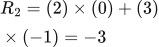
R_2=(2)\times(0)+(3)\times(-1)=-3Add the rows to obtain one output cell.
 LaTeX:
Y_{3,3}=(0)+(-3)=-3Final output: 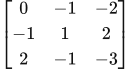 LaTeX:
\begin{bmatrix}0 & -1 & -2\\-1 & 1 & 2\\2 & -1 & -3\end{bmatrix}. Each output came from its own complete window; stride changes the next window position, not the multiplication rule.
ReLU turns negative entries into 0:  LaTeX:
\begin{bmatrix}0 & 0 & 0\\0 & 1 & 2\\2 & 0 & 0\end{bmatrix}.
Shape: 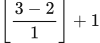 LaTeX:
\left\lfloor\frac{3-2}{1}\right\rfloor+1 = 2 on each axis; channels stay unchanged.
Pooling window (1,1)
Step 1: select the entries.
[0, 0, 0, 1]
Step 2: add all selected entries.
0 + 0 + 0 + 1 = 1
Step 3: divide by the 4 entries in this window.
1/4 = 0.25. Maximum = 1
Pooling window (1,2)
Step 1: select the entries.
[0, 0, 1, 2]
Step 2: add all selected entries.
0 + 0 + 1 + 2 = 3
Step 3: divide by the 4 entries in this window.
3/4 = 0.75. Maximum = 2
Pooling window (2,1)
Step 1: select the entries.
[0, 1, 2, 0]
Step 2: add all selected entries.
0 + 1 + 2 + 0 = 3
Step 3: divide by the 4 entries in this window.
3/4 = 0.75. Maximum = 2
Pooling window (2,2)
Step 1: select the entries.
[1, 2, 0, 0]
Step 2: add all selected entries.
1 + 2 + 0 + 0 = 3
Step 3: divide by the 4 entries in this window.
3/4 = 0.75. Maximum = 2
Average output: 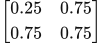 LaTeX:
\begin{bmatrix}0.25 & 0.75\\0.75 & 0.75\end{bmatrix}. Max output:  LaTeX:
\begin{bmatrix}1 & 2\\2 & 2\end{bmatrix}. Pooling normally has zero trainable parameters and reduces spatial dimensions.
Use MAX output and flatten rowwise: [1, 2, 2, 2]. Dense z = 0.1 × 1 + 0.2 × 2 + 0.3 × 2 + 0.4 × 2 = 1.9. p = σ(1.9) = 0.869891526. BCE = −ln(p) = 0.139386758. Average pool values were computed for contrast; the question requires max pool.