Deep Learning · TEE · formulas
BPTT hidden delta
At an RNN hidden state, a loss gradient can arrive from the current output and from the next time step. Add these two contributions, then multiply by the local activation derivative. The displayed output term p−y assumes softmax with categorical cross-entropy.
 LaTeX:
\delta_t=\left[W_{hy}^T(p_t-y_t)+W_{hh}^T\delta_{t+1}\right]\odot(1-h_t^2)How an RNN is trained
Definition. Backpropagation through time (BPTT) differentiates the loss of an RNN by applying backpropagation to its temporally unrolled computational graph and summing contributions to shared parameters.
Explanation and working
Unroll the recurrent network for the sequence length. Run the forward calculation in time order. Calculate the specified loss. Differentiate backwards through the unrolled graph. Add contributions to each shared weight from every time it was used. Update each shared weight once for the selected sequence or batch. This is backpropagation through time, or BPTT.
For tanh, let δₜ mean the gradient with respect to the hidden preactivation. The following form allows losses at several time steps; a missing output loss contributes zero.
 LaTeX:
\delta_t=\left(W_{hy}^{T}\delta_t^{out}+W_{hh}^{T}\delta_{t+1}\right)\odot(1-h_t^2)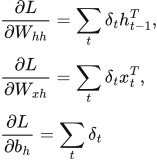 LaTeX:
\frac{\partial L}{\partial W_{hh}}=\sum_t\delta_t h_{t-1}^{T},\quad \frac{\partial L}{\partial W_{xh}}=\sum_t\delta_t x_t^{T},\quad \frac{\partial L}{\partial b_h}=\sum_t\delta_tThe symbol ⊙ means pairwise multiplication. The transpose T turns a column into a row. δnext carries the effect of future time steps. The summation is essential because these are shared parameters.
One BPTT delta at h = 0.5
Question. In a scalar tanh RNN, h_t = 0.5, current output-path derivative = 0.2, next-step delta = 0.3 and recurrent weight = 0.4. Find the current preactivation delta.
Given
Activated h_t = 0.5; q_t = 0.2; δ_(t+1) = 0.3; recurrent weight u = 0.4.
To find
Current preactivation delta δ_t.
Formula — which one and why
Two paths affect the current hidden state: its current output and the future recurrent step. Add both before differentiating the current tanh.
q_t is already a derivative with respect to the hidden activation; the next delta is with respect to next preactivation.
 LaTeX:
\delta_t=(q_t+u\delta_{t+1})(1-h_t^2)Yaad rakhne ka cue: Future aur current dono add; tanh slope uske baad.
Solution — step by step
Step 1: calculate the future path contribution.
 LaTeX:
0.4(0.3)=0.12Step 2: add the current output contribution.
 LaTeX:
0.2+0.12=0.32Step 3: calculate the current tanh slope.
 LaTeX:
1-(0.5)^2=0.75Step 4: multiply by that slope.
 LaTeX:
\delta_t=(0.32)(0.75)=0.24Final answer: δ_t = 0.24.
One BPTT delta at h = -0.2
Question. In a scalar tanh RNN, h_t = -0.2, current output-path derivative = 0.1, next-step delta = 0 and recurrent weight = 0.5. Find the current preactivation delta.
Given
Activated h_t = -0.2; q_t = 0.1; δ_(t+1) = 0; recurrent weight u = 0.5.
To find
Current preactivation delta δ_t.
Formula — which one and why
Two paths affect the current hidden state: its current output and the future recurrent step. Add both before differentiating the current tanh.
q_t is already a derivative with respect to the hidden activation; the next delta is with respect to next preactivation.
LaTeX: \delta_t=(q_t+u\delta_{t+1})(1-h_t^2)Yaad rakhne ka cue: Future aur current dono add; tanh slope uske baad.
Solution — step by step
Step 1: calculate the future path contribution.
 LaTeX:
0.5(0)=0Step 2: add the current output contribution.
 LaTeX:
0.1+0=0.1Step 3: calculate the current tanh slope.
 LaTeX:
1-(-0.2)^2=0.96Step 4: multiply by that slope.
 LaTeX:
\delta_t=(0.1)(0.96)=0.096Final answer: δ_t = 0.096.
Question. In a scalar tanh RNN, the current hidden state is hₜ = 0.6. The current output path contributes 0.1 to the derivative with respect to hₜ. The next hidden preactivation has delta 0.4 and recurrent weight 0.5. Find the current hidden preactivation delta.
Given
Current hₜ = 0.6; local output-path derivative = 0.1.
Next-step delta = 0.4; recurrent weight = 0.5; current activation = tanh.
To find
Find the current hidden preactivation delta.
Formula — which one and why
Current and future recurrent paths. Add the local-output contribution and the weighted next-step delta, then multiply by the current tanh slope.
hₜ = current activated state; qₜ = current output-path derivative; u = recurrent weight; δₜ₊₁ = next-step preactivation delta.
LaTeX: \delta_t=(q_t+u\delta_{t+1})(1-h_t^2)Yaad rakhne ka cue: Current path plus future path, phir current activation slope.
Solution — step by step
The next-step contribution must travel through the recurrent weight. Multiply that weight by the supplied next delta.
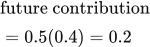 LaTeX:
\text{future contribution}=0.5(0.4)=0.2Add the current output-path contribution. These are two routes to the same hidden state, so addition is required.
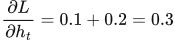 LaTeX:
\frac{\partial L}{\partial h_t}=0.1+0.2=0.3The current activation is tanh. Its derivative uses the current activated value hₜ.
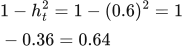 LaTeX:
1-h_t^2=1-(0.6)^2=1-0.36=0.64Multiply the combined gradient by this local derivative.
 LaTeX:
\delta_t=0.3(0.64)=0.192Final answer: δₜ = 0.192. This is the derivative with respect to the current hidden raw score. At the last step, there is no future-state contribution unless the question connects another computation there.
One BPTT delta at h = 0.5
Question. In a scalar tanh RNN, h_t = 0.5, current output-path derivative = 0.2, next-step delta = 0.3 and recurrent weight = 0.4. Find the current preactivation delta.
Given
Activated h_t = 0.5; q_t = 0.2; δ_(t+1) = 0.3; recurrent weight u = 0.4.
To find
Current preactivation delta δ_t.
Formula — which one and why
Two paths affect the current hidden state: its current output and the future recurrent step. Add both before differentiating the current tanh.
q_t is already a derivative with respect to the hidden activation; the next delta is with respect to next preactivation.
LaTeX: \delta_t=(q_t+u\delta_{t+1})(1-h_t^2)Yaad rakhne ka cue: Future aur current dono add; tanh slope uske baad.
Solution — step by step
Step 1: calculate the future path contribution.
LaTeX: 0.4(0.3)=0.12Step 2: add the current output contribution.
LaTeX: 0.2+0.12=0.32Step 3: calculate the current tanh slope.
LaTeX: 1-(0.5)^2=0.75Step 4: multiply by that slope.
LaTeX: \delta_t=(0.32)(0.75)=0.24Final answer: δ_t = 0.24.
One BPTT delta at h = -0.2
Question. In a scalar tanh RNN, h_t = -0.2, current output-path derivative = 0.1, next-step delta = 0 and recurrent weight = 0.5. Find the current preactivation delta.
Given
Activated h_t = -0.2; q_t = 0.1; δ_(t+1) = 0; recurrent weight u = 0.5.
To find
Current preactivation delta δ_t.
Formula — which one and why
Two paths affect the current hidden state: its current output and the future recurrent step. Add both before differentiating the current tanh.
q_t is already a derivative with respect to the hidden activation; the next delta is with respect to next preactivation.
LaTeX: \delta_t=(q_t+u\delta_{t+1})(1-h_t^2)Yaad rakhne ka cue: Future aur current dono add; tanh slope uske baad.
Solution — step by step
Step 1: calculate the future path contribution.
LaTeX: 0.5(0)=0Step 2: add the current output contribution.
LaTeX: 0.1+0=0.1Step 3: calculate the current tanh slope.
LaTeX: 1-(-0.2)^2=0.96Step 4: multiply by that slope.
LaTeX: \delta_t=(0.1)(0.96)=0.096Final answer: δ_t = 0.096.