Deep Learning · TEE · formulas
GRU state under the retain-old convention
Some GRU questions use the opposite naming convention: z is the fraction of the OLD state retained. The formula below uses that convention. Do not combine its formula with an explanation that says z retains the new candidate.
 LaTeX:
\widetilde h_t=\tanh(W_hx_t+U_h(r_t\odot h_{t-1})+b_h)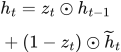 LaTeX:
h_t=z_t\odot h_{t-1}+(1-z_t)\odot\widetilde h_tQuestion. Use the retain-old GRU convention. Given hprevious = 0.4, reset gate r = 0.5, update gate z = 0.25, x = 1, W = 0.2, U = 0.5 and b = 0, calculate the candidate and the next hidden state.
Given
h_old = 0.4; r = 0.5; z = 0.25; x = 1.
W = 0.2; U = 0.5; b = 0; z retains the old state.
To find
Find the candidate and new hidden state.
Formula — which one and why
GRU with a retain-old update gate. Form the candidate using reset memory; then z retains the old state and 1−z admits the candidate. Follow this question-specific convention.
r = reset gate; z = retain-old gate; h_old = previous state; h̃ = candidate.
 LaTeX:
\widetilde h=\tanh(Wx+U(rh_{\mathrm{old}})+b) LaTeX:
h_{\mathrm{new}}=zh_{\mathrm{old}}+(1-z)\widetilde hYaad rakhne ka cue: Question mein z kisko multiply karta hai wahi meaning; yahan old ko retain.
Solution — step by step
Step 1: reset the old state for candidate formation.
 LaTeX:
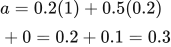
r h_{\mathrm{previous}}=0.5(0.4)=0.2Step 2: calculate the candidate's raw input. Its new-input contribution is 0.2 × 1; its reset-memory contribution is 0.5 × 0.2.
 LaTeX:
a=0.2(1)+0.5(0.2)+0=0.2+0.1=0.3Step 3: apply tanh to this raw input.
 LaTeX:
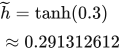
\widetilde h=\tanh(0.3)\approx0.291312612Step 4: calculate how much old state is retained. In this question, z = 0.25 multiplies the original old state 0.4.
 LaTeX:
z h_{\mathrm{previous}}=0.25(0.4)=0.1Step 5: calculate how much candidate is admitted. The other fraction is 1 − z = 0.75.
 LaTeX:
1-z=1-0.25=0.75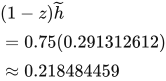 LaTeX:
(1-z)\widetilde h=0.75(0.291312612)\approx0.218484459Step 6: add the two final contributions.
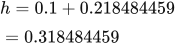 LaTeX:
h=0.1+0.218484459=0.318484459Final answer: h ≈ 0.318484459. The candidate was 0.291312612; the final hidden state is a mixture of that candidate and the original old state. Under the admit-new convention with the same numeric z, the result would instead be 0.372828153.
Retain-old GRU with gate 0
Question. Use h_new = z h_old+(1−z) candidate. Given h_old = 0.4, z = 0, r = 0.5, x = 1, W = 0.2, U = 0.5 and b = 0, calculate the candidate and new state.
Given
h_old = 0.4; z = 0; r = 0.5; x = 1.
W = 0.2; U = 0.5; b = 0; z is the retain-old gate.
To find
Candidate and final hidden state.
Formula — which one and why
The reset gate changes old-state input to the candidate. The update gate separately mixes the original old state and candidate.
The question explicitly makes z multiply the old state. r and z do different jobs.
LaTeX: \widetilde h=\tanh(Wx+U(rh_{\mathrm{old}})+b)LaTeX: h_{\mathrm{new}}=zh_{\mathrm{old}}+(1-z)\widetilde hYaad rakhne ka cue: Reset sirf candidate mein; update mix mein original old state.
Solution — step by step
Step 1: reset the old state for candidate formation.
 LaTeX:
rh_{\mathrm{old}}=0.5(0.4)=0.2Step 2: calculate the candidate raw sum.
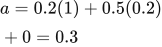 LaTeX:
a=0.2(1)+0.5(0.2)+0=0.3Step 3: apply tanh.
LaTeX: \widetilde h=\tanh(0.3)\approx0.291312612Step 4: retain the old-state fraction.
 LaTeX:
0(0.4)=0Step 5: calculate the candidate fraction.
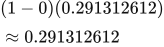 LaTeX:
(1-0)(0.291312612)\approx0.291312612Step 6: add the two fractions.
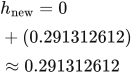 LaTeX:
h_{\mathrm{new}}=0+(0.291312612)\approx0.291312612Final answer: Candidate ≈ 0.291312612; new state ≈ 0.291312612.
Retain-old GRU with gate 0.8
Question. Use h_new = z h_old+(1−z) candidate. Given h_old = -0.2, z = 0.8, r = 0.5, x = 1, W = 0.2, U = 0.5 and b = 0, calculate the candidate and new state.
Given
h_old = -0.2; z = 0.8; r = 0.5; x = 1.
W = 0.2; U = 0.5; b = 0; z is the retain-old gate.
To find
Candidate and final hidden state.
Formula — which one and why
The reset gate changes old-state input to the candidate. The update gate separately mixes the original old state and candidate.
The question explicitly makes z multiply the old state. r and z do different jobs.
LaTeX: \widetilde h=\tanh(Wx+U(rh_{\mathrm{old}})+b)LaTeX: h_{\mathrm{new}}=zh_{\mathrm{old}}+(1-z)\widetilde hYaad rakhne ka cue: Reset sirf candidate mein; update mix mein original old state.
Solution — step by step
Step 1: reset the old state for candidate formation.
 LaTeX:
rh_{\mathrm{old}}=0.5(-0.2)=-0.1Step 2: calculate the candidate raw sum.
 LaTeX:
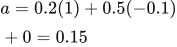
a=0.2(1)+0.5(-0.1)+0=0.15Step 3: apply tanh.
 LaTeX:
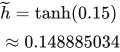
\widetilde h=\tanh(0.15)\approx0.148885034Step 4: retain the old-state fraction.
 LaTeX:
0.8(-0.2)=-0.16Step 5: calculate the candidate fraction.
 LaTeX:
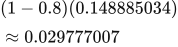
(1-0.8)(0.148885034)\approx0.029777007Step 6: add the two fractions.
 LaTeX:
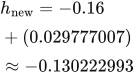
h_{\mathrm{new}}=-0.16+(0.029777007)\approx-0.130222993Final answer: Candidate ≈ 0.148885034; new state ≈ -0.130222993.