Deep Learning · TEE · formulas
Tanh and its derivative
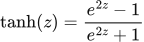
Tanh can produce a negative or positive output. In the formula, calculate the exponential first, then form the top and bottom of the fraction separately. The derivative uses the activated answer, not the raw input.
 LaTeX:
\tanh(z)=\frac{e^{2z}-1}{e^{2z}+1} LaTeX:
\tanh\prime(z)=1-\tanh^2(z)Question. Calculate tanh(0.5) and its derivative with respect to the input.
Given
z = 0.5.
To find
Find tanh(z) and its derivative.
Formula — which one and why
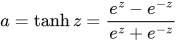
Tanh and its slope. Tanh preserves a signed output between −1 and 1. Once its output a is known, the local slope is 1−a².
z = value entering tanh; a = its output. A prime means derivative, or local rate of change.
 LaTeX:
a=\tanh z=\frac{e^z-e^{-z}}{e^z+e^{-z}}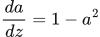 LaTeX:
\frac{da}{dz}=1-a^2Yaad rakhne ka cue: Tanh signed output deta hai; slope = 1 minus output ka square.
Solution — step by step
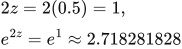
Step 1: identify the input. The input z is 0.5. In this version of the tanh formula, the exponential uses 2z.
 LaTeX:
2z=2(0.5)=1,\qquad e^{2z}=e^1\approx2.718281828Step 2: calculate the numerator. Subtract 1 from that exponential.
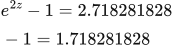 LaTeX:
e^{2z}-1=2.718281828-1=1.718281828Step 3: calculate the denominator. Add 1 to the same exponential.
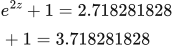 LaTeX:
e^{2z}+1=2.718281828+1=3.718281828Step 4: divide the top by the bottom.
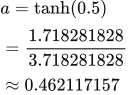 LaTeX:
a=\tanh(0.5)=\frac{1.718281828}{3.718281828}\approx0.462117157Step 5: calculate the local derivative. Square the output a and subtract it from 1. Keep the calculator's unrounded result.
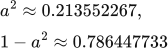 LaTeX:
a^2\approx0.213552267,\qquad1-a^2\approx0.786447733Final answer: tanh output ≈ 0.462117157; local derivative ≈ 0.786447733. The output becomes the next layer's input; the derivative is used when carrying a gradient backward.
tanh example 1
Question. For preactivation z = -2, calculate the tanh output and state its derivative.
Given
z = -2; activation = tanh.
To find
The output a and the derivative with respect to z.
Formula — which one and why
Use the activation named in the question. The derivative is a second calculation required for a backward pass.
z is the raw sum; a is the activated output; f′(z) is the local slope.
 LaTeX:
a=\frac{e^{2z}-1}{e^{2z}+1} LaTeX:
f\prime(z)=1-a^2Yaad rakhne ka cue: Tanh ka answer −1 se 1; slope one minus output squared.
Solution — step by step
Step 1: double z before exponentiation.
 LaTeX:
2z=2(-2)=-4Step 2: calculate the exponential.
 LaTeX:
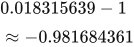
e^{-4}\approx0.018315639Step 3: calculate numerator and denominator separately.
 LaTeX:
0.018315639-1\approx-0.981684361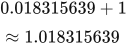 LaTeX:
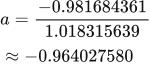
0.018315639+1\approx1.018315639Step 4: divide.
 LaTeX:
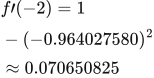
a=\frac{-0.981684361}{1.018315639}\approx-0.964027580Step 5: square the activated output for its slope.
 LaTeX:
f\prime(-2)=1-(-0.964027580)^2\approx0.070650825Final answer: a ≈ -0.964027580. Derivative ≈ 0.070650825.
tanh example 2
Question. For preactivation z = 0, calculate the tanh output and state its derivative.
Given
z = 0; activation = tanh.
To find
The output a and the derivative with respect to z.
Formula — which one and why
Use the activation named in the question. The derivative is a second calculation required for a backward pass.
z is the raw sum; a is the activated output; f′(z) is the local slope.
LaTeX: a=\frac{e^{2z}-1}{e^{2z}+1}LaTeX: f\prime(z)=1-a^2Yaad rakhne ka cue: Tanh ka answer −1 se 1; slope one minus output squared.
Solution — step by step
Step 1: double z before exponentiation.
 LaTeX:
2z=2(0)=0Step 2: calculate the exponential.
 LaTeX:
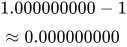
e^{0}\approx1.000000000Step 3: calculate numerator and denominator separately.
 LaTeX:
1.000000000-1\approx0.000000000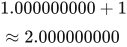 LaTeX:
1.000000000+1\approx2.000000000Step 4: divide.
 LaTeX:
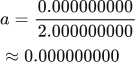
a=\frac{0.000000000}{2.000000000}\approx0.000000000Step 5: square the activated output for its slope.
 LaTeX:
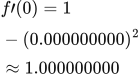
f\prime(0)=1-(0.000000000)^2\approx1.000000000Final answer: a ≈ 0.000000000. Derivative ≈ 1.000000000.
tanh example 3
Question. For preactivation z = 2, calculate the tanh output and state its derivative.
Given
z = 2; activation = tanh.
To find
The output a and the derivative with respect to z.
Formula — which one and why
Use the activation named in the question. The derivative is a second calculation required for a backward pass.
z is the raw sum; a is the activated output; f′(z) is the local slope.
LaTeX: a=\frac{e^{2z}-1}{e^{2z}+1}LaTeX: f\prime(z)=1-a^2Yaad rakhne ka cue: Tanh ka answer −1 se 1; slope one minus output squared.
Solution — step by step
Step 1: double z before exponentiation.
 LaTeX:
2z=2(2)=4Step 2: calculate the exponential.
 LaTeX:
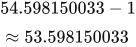
e^{4}\approx54.598150033Step 3: calculate numerator and denominator separately.
 LaTeX:
54.598150033-1\approx53.598150033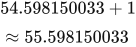 LaTeX:
54.598150033+1\approx55.598150033Step 4: divide.
 LaTeX:
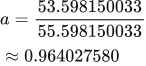
a=\frac{53.598150033}{55.598150033}\approx0.964027580Step 5: square the activated output for its slope.
 LaTeX:
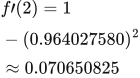
f\prime(2)=1-(0.964027580)^2\approx0.070650825Final answer: a ≈ 0.964027580. Derivative ≈ 0.070650825.