Deep Learning · TEE · section
R26 Q7a
Re examination February 2026 fully solved
Question
Question (10 marks). Compare single-layer and multilayer feedforward networks and explain hidden nonlinearity. Compute the output for Input x = [0.5, 0.2, 0.1]. Each row below lists the incoming weights of one receiving neuron. W₁ is shown below; b₁ = [0.1, 0.2]; W₂ is shown below; b₂ = [0.5]. Hidden and output activations are sigmoid.
Answer — step by step
Given
Input x = [0.5, 0.2, 0.1].
W₁ is printed with the question.
b₁ = [0.1, 0.2].
W₂ is printed with the question.
b₂ = [0.5].
Hidden and output activations are sigmoid.
To find
Find all preactivations, hidden activations and final outputs. Find the sigmoid output and, if requested, its derivative.
Formula — which one and why
Forward propagation. Evaluate one layer completely before supplying its activated outputs to the next layer. Each layer has its own weights and biases.
x = input vector; h = hidden outputs; W₁,b₁ = hidden parameters; W₂,b₂ = output parameters; f₁,f₂ = the stated activations.
 LaTeX:
z_h=W_1x+b_1 LaTeX:
h=f_1(z_h) LaTeX:
z_o=W_2h+b_2 LaTeX:
o=f_2(z_o)Yaad rakhne ka cue: Pehli layer ka activated output hi agli layer ka input hai.
Sigmoid and its slope. Use sigmoid when the neuron is specified to squash its preactivation into (0,1). Once its output is known, its derivative needs only output × (1−output).
z = preactivation; p = sigmoid output; e is the exponential base, not a prediction error in this formula.
 LaTeX:
p=\frac{1}{1+e^{-z}}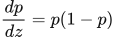 LaTeX:
\frac{dp}{dz}=p(1-p)Yaad rakhne ka cue: Sigmoid output p; uska slope p × (1−p).
Solution — step by step
A single perceptron forms a weighted sum and applies a threshold. Its decision boundary is linear: w·x+b = 0. It can learn linearly separable patterns such as AND and OR under suitable learning conditions, but cannot represent XOR with one linear separator.
For binary AND, w₁ = w₂ = 1 and b = −1.5 give preactivations −1.5, −0.5, −0.5 and 0.5 for 00, 10, 01 and 11. A step that returns 1 at nonnegative inputs produces 0,0,0,1.
For XOR, use h₁ = step(x₁+x₂−0.5) for OR and h₂ = step(x₁+x₂−1.5) for AND. Then XOR = step(h₁−2h₂−0.5). For inputs 00,01,10,11, the hidden pairs are (0,0), (1,0), (1,0), (1,1), producing 0,1,1,0. XNOR = step(−h₁+2h₂+0.5), producing 1,0,0,1. This is a multilayer construction, not a claim that a single perceptron solves XOR.
A multilayer feedforward network adds hidden nonlinear features before the final boundary. Without hidden nonlinearities, adding linear layers still produces one affine map.
Step 1 map the arrows. Each row of W₁ receives all inputs; each row of W₂ receives all hidden outputs. Bias is added once per receiving neuron.
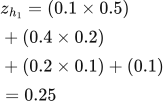
Hidden neuron 1:
 LaTeX:
z_{h_1} = (0.1 \times 0.5) + (0.4 \times 0.2) + (0.2 \times 0.1) + (0.1) = 0.25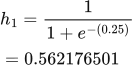 LaTeX:
h_{1}=\frac{1}{1+e^{-(0.25)}}=0.562176501Hidden neuron 2:
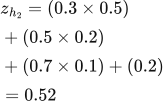 LaTeX:
z_{h_2} = (0.3 \times 0.5) + (0.5 \times 0.2) + (0.7 \times 0.1) + (0.2) = 0.52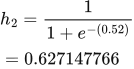 LaTeX:
h_{2}=\frac{1}{1+e^{-(0.52)}}=0.627147766Output neuron 1:
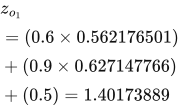 LaTeX:
z_{o_1} = (0.6 \times 0.562176501) + (0.9 \times 0.627147766) + (0.5) = 1.40173889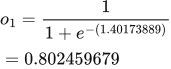 LaTeX:
o_{1}=\frac{1}{1+e^{-(1.40173889)}}=0.802459679