Deep Learning · TEE · section
R26 Q3a
Re examination February 2026 fully solved
Question
Question (10 marks). Train a perceptron for one epoch, η = 1, initial weights and bias 0, threshold 0. Samples: [−1,1,−1] → −1; [1,1,1] → 1; [−1,−1,1] → −1; [−1,1,1] → −1. Discuss limitations with examples.
Answer — step by step
Given
Train a perceptron for one epoch, η = 1, initial weights and bias 0, threshold 0.
Samples: [−1,1,−1] → −1.
[1,1,1] → 1.
[−1,−1,1] → −1.
[−1,1,1] → −1.
To find
Process samples in order for the stated epochs and report the final weights and bias.
Formula — which one and why
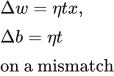
Target-based perceptron correction. This worked convention changes parameters only on a wrong prediction. Use the target itself as the signed multiplier; it differs from the binary error rule.
t is the bipolar target; η is the learning rate. Output is +1 above zero, −1 below zero and 0 at exactly zero.
 LaTeX:
\Delta w=\eta t x,\quad\Delta b=\eta t\quad\text{on a mismatch}Yaad rakhne ka cue: Is convention mein galat hua toh target × input se correction.
Solution — step by step
State the threshold rule. Use output +1 if z>0, −1 if z<0, and 0 at z = 0. On a mismatch use Δw = η tx and Δb = ηt; on a match make no update. η = 1. A different rule at zero can change the learning trajectory. Write your convention explicitly.
Epoch 1, sample 1
Step 1: copy this sample and target.
x = [-1, 1, -1], target = -1.
Step 2: calculate the current net.
z = (0 × -1) + (0 × 1) + (0 × -1) + (0) = 0
Step 3: apply the threshold.
output = 0.
Step 4: calculate the update multiplier.
Update multiplier = -1
Step 5: calculate all weight changes.
Δw = -1 × [-1, 1, -1] = [1, -1, 1]
Step 6: calculate the bias change.
Δb = -1.
Step 7: carry the updated parameters forward.
New w = [1, -1, 1], new b = -1.
Epoch 1, sample 2
Step 1: copy this sample and target.
x = [1, 1, 1], target = 1.
Step 2: calculate the current net.
z = (1 × 1) + (-1 × 1) + (1 × 1) + (-1) = 0
Step 3: apply the threshold.
output = 0.
Step 4: calculate the update multiplier.
Update multiplier = 1
Step 5: calculate all weight changes.
Δw = 1 × [1, 1, 1] = [1, 1, 1]
Step 6: calculate the bias change.
Δb = 1.
Step 7: carry the updated parameters forward.
New w = [2, 0, 2], new b = 0.
Epoch 1, sample 3
Step 1: copy this sample and target.
x = [-1, -1, 1], target = -1.
Step 2: calculate the current net.
z = (2 × -1) + (0 × -1) + (2 × 1) + (0) = 0
Step 3: apply the threshold.
output = 0.
Step 4: calculate the update multiplier.
Update multiplier = -1
Step 5: calculate all weight changes.
Δw = -1 × [-1, -1, 1] = [1, 1, -1]
Step 6: calculate the bias change.
Δb = -1.
Step 7: carry the updated parameters forward.
New w = [3, 1, 1], new b = -1.
Epoch 1, sample 4
Step 1: copy this sample and target.
x = [-1, 1, 1], target = -1.
Step 2: calculate the current net.
z = (3 × -1) + (1 × 1) + (1 × 1) + (-1) = -2
Step 3: apply the threshold.
output = -1.
Step 4: calculate the update multiplier.
Update multiplier = 0
Step 5: calculate all weight changes.
Δw = 0 × [-1, 1, 1] = [0, 0, 0]
Step 6: calculate the bias change.
Δb = 0.
Step 7: carry the updated parameters forward.
New w = [3, 1, 1], new b = -1.
Final after exactly the requested epochs: w = [3, 1, 1], b = -1. A finite number of requested epochs does not itself prove convergence or correct classification of every sample.
A single perceptron forms a weighted sum and applies a threshold. Its decision boundary is linear: w·x+b = 0. It can learn linearly separable patterns such as AND and OR under suitable learning conditions, but cannot represent XOR with one linear separator.
For binary AND, w₁ = w₂ = 1 and b = −1.5 give preactivations −1.5, −0.5, −0.5 and 0.5 for 00, 10, 01 and 11. A step that returns 1 at nonnegative inputs produces 0,0,0,1.
For XOR, use h₁ = step(x₁+x₂−0.5) for OR and h₂ = step(x₁+x₂−1.5) for AND. Then XOR = step(h₁−2h₂−0.5). For inputs 00,01,10,11, the hidden pairs are (0,0), (1,0), (1,0), (1,1), producing 0,1,1,0. XNOR = step(−h₁+2h₂+0.5), producing 1,0,0,1. This is a multilayer construction, not a claim that a single perceptron solves XOR.
A multilayer feedforward network adds hidden nonlinear features before the final boundary. Without hidden nonlinearities, adding linear layers still produces one affine map.
Key correction: recomputing each net with the latest weights gives net values 0,0,0,−2 and final w = [3,1,1], b = −1 under the stated bipolar rule. The supplied answer-key table contains inconsistent intermediate arithmetic.