Deep Learning · TEE · section
R24 Q6a
Re examination February 2024 fully solved
Question
Question (10 marks). For a GRU time step, explain the significance of update and reset gates and develop their equations.
Answer — step by step
A GRU uses an update gate and reset gate, with one hidden state and no separate LSTM-style cell state. Under the convention used here, z admits the new candidate:
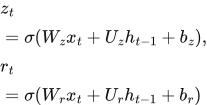 LaTeX:
z_t=\sigma(W_zx_t+U_zh_{t-1}+b_z),\quad r_t=\sigma(W_rx_t+U_rh_{t-1}+b_r)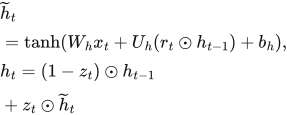 LaTeX:
\widetilde h_t=\tanh(W_hx_t+U_h(r_t\odot h_{t-1})+b_h),\quad h_t=(1-z_t)\odot h_{t-1}+z_t\odot\widetilde h_tThe reset gate controls how much prior hidden information enters the candidate. The update gate balances retention and replacement. A small z retains most of the old state under this formula; another textbook convention swaps z and 1−z. State the formula before interpreting the gate.
Compared with an LSTM's input, forget and output gates plus candidate transform, a standard GRU has two gates plus a candidate transform and usually fewer parameters at equal hidden width. This may reduce training cost and the amount of data needed to estimate parameters, but small-dataset superiority is not guaranteed. Validation should decide. To ignore an unhelpful token, a trained GRU can keep the prior state by admitting little candidate content; it still executes the recurrence rather than literally deleting the token. Both GRU and LSTM help long-range learning compared with an ungated vanilla RNN.