Deep Learning · TEE · section
F22 Q2a
Final examination November 2022 fully solved
Question
Question (10 marks). Explain GRU advantages over a normal RNN. For “The student who did not submit the assignment was bound to loose marks,” show how memory and update gates can retain the subject before predicting “was”.
Answer — step by step
A GRU uses an update gate and reset gate, with one hidden state and no separate LSTM-style cell state. Under the convention used here, z admits the new candidate:
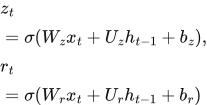 LaTeX:
z_t=\sigma(W_zx_t+U_zh_{t-1}+b_z),\quad r_t=\sigma(W_rx_t+U_rh_{t-1}+b_r)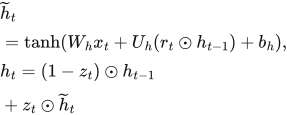 LaTeX:
\widetilde h_t=\tanh(W_hx_t+U_h(r_t\odot h_{t-1})+b_h),\quad h_t=(1-z_t)\odot h_{t-1}+z_t\odot\widetilde h_tThe reset gate controls how much prior hidden information enters the candidate. The update gate balances retention and replacement. A small z retains most of the old state under this formula; another textbook convention swaps z and 1−z. State the formula before interpreting the gate.
Compared with an LSTM's input, forget and output gates plus candidate transform, a standard GRU has two gates plus a candidate transform and usually fewer parameters at equal hidden width. This may reduce training cost and the amount of data needed to estimate parameters, but small-dataset superiority is not guaranteed. Validation should decide. To ignore an unhelpful token, a trained GRU can keep the prior state by admitting little candidate content; it still executes the recurrence rather than literally deleting the token. Both GRU and LSTM help long-range learning compared with an ungated vanilla RNN.
Important data limit: no numerical weights or token vectors are supplied, so actual gate outputs cannot be uniquely calculated. The following is an explicitly idealized one-component illustration: candidate subject feature = 1 at “student”; use hnew = (1−z) hold+z candidate. Exact 0/1 gates are limiting idealizations of sigmoid values.
| Time and token | Illustrative z | Singular-subject memory after step |
|---|---|---|
| 1 The | 0 while retaining this illustrative feature | 0 before subject is read |
| 2 student | 1 when admitting subject feature | 1 after subject is read |
| 3 who | 0 while retaining this illustrative feature | 1 after subject is read |
| 4 did | 0 while retaining this illustrative feature | 1 after subject is read |
| 5 not | 0 while retaining this illustrative feature | 1 after subject is read |
| 6 submit | 0 while retaining this illustrative feature | 1 after subject is read |
| 7 the | 0 while retaining this illustrative feature | 1 after subject is read |
| 8 assignment | 0 while retaining this illustrative feature | 1 after subject is read |
At “student”: hnew = (1−1) × 0+1 × 1 = 1. At each intervening token in this illustrative component: hnew = (1−0) × 1+0 × candidate = 1. The retained singular subject helps the output layer choose “was”. Other hidden components may still update to represent intervening words; this table is not a computed trace from an actual trained network.