Deep Learning · TEE · section
R23 Q5b
Re examination January 2023 fully solved
Question
Question (10 marks). Justify multiple ANN layers. Design a fraudulent/non-fraudulent transaction classifier for 10,000 samples with 4 features; choose layers/units and count parameters.
Answer — step by step
Given
10,000 samples; 4 features per sample; two target classes: fraudulent/non-fraudulent.
Hidden layer sizes are design choices, not fixed in the question.
To find
Explain multiple layers, propose an appropriate classifier and count parameters for that explicit design.
Formula — which one and why
Dense-layer parameters. Every output neuron receives every input, so multiply inputs by outputs for weights. Add one bias per receiving neuron. Sum separate layers.
n_in = incoming features; n_out = receiving neurons. The input layer itself has no learned receiving weights or biases.
 LaTeX:
P=(n_{\mathrm{in}}+1)n_{\mathrm{out}}Yaad rakhne ka cue: Har output ke liye saare inputs plus ek bias.
Solution — step by step
A single perceptron forms a weighted sum and applies a threshold. Its decision boundary is linear: w·x+b = 0. It can learn linearly separable patterns such as AND and OR under suitable learning conditions, but cannot represent XOR with one linear separator.
For binary AND, w₁ = w₂ = 1 and b = −1.5 give preactivations −1.5, −0.5, −0.5 and 0.5 for 00, 10, 01 and 11. A step that returns 1 at nonnegative inputs produces 0,0,0,1.
For XOR, use h₁ = step(x₁+x₂−0.5) for OR and h₂ = step(x₁+x₂−1.5) for AND. Then XOR = step(h₁−2h₂−0.5). For inputs 00,01,10,11, the hidden pairs are (0,0), (1,0), (1,0), (1,1), producing 0,1,1,0. XNOR = step(−h₁+2h₂+0.5), producing 1,0,0,1. This is a multilayer construction, not a claim that a single perceptron solves XOR.
A multilayer feedforward network adds hidden nonlinear features before the final boundary. Without hidden nonlinearities, adding linear layers still produces one affine map.
Chosen design: 4 → 8 → 4 → 1 with ReLU hidden layers, one sigmoid output and binary cross-entropy. Hidden widths are explicit design assumptions.
Architecture: 4 → 8 → 4 → 1. Each non-input neuron has one bias.
Layer 4 → 8
Step 1: count connections.
 LaTeX:
4(8)=32Step 2: count receiving-neuron biases.
There are 8 receiving neurons, so 8 biases.
Step 3: add weights and biases.
 LaTeX:
32+8=40Layer 8 → 4
Step 1: count connections.
 LaTeX:
8(4)=32Step 2: count receiving-neuron biases.
There are 4 receiving neurons, so 4 biases.
Step 3: add weights and biases.
 LaTeX:
32+4=36Layer 4 → 1
Step 1: count connections.
 LaTeX:
4(1)=4Step 2: count receiving-neuron biases.
There are 1 receiving neurons, so 1 biases.
Step 3: add weights and biases.
 LaTeX:
4+1=5Total = 81. Input values and activations are not trainable parameters.
Use stratified train/validation/test partitions; handle class imbalance using appropriate training weights and evaluate precision/recall or a suitable decision threshold alongside accuracy. More layers are useful only if they learn needed nonlinear structure; the problem statement does not prescribe one uniquely correct architecture.
Verify input (0,0)
Step 1: calculate hidden OR preactivation.
 LaTeX:
z_1=0+0-0.5=-0.5Step 2: apply its threshold.
 LaTeX:
h_1=0Step 3: calculate hidden AND preactivation.
 LaTeX:
z_2=0+0-1.5=-1.5Step 4: apply its threshold.
 LaTeX:
h_2=0Step 5: calculate XOR output preactivation.
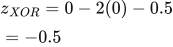 LaTeX:
z_{XOR}=0-2(0)-0.5=-0.5Step 6: apply the XOR threshold.
 LaTeX:
y_{XOR}=0Step 7: calculate XNOR output preactivation.
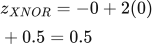 LaTeX:
z_{XNOR}=-0+2(0)+0.5=0.5Step 8: apply the XNOR threshold.
 LaTeX:
y_{XNOR}=1Verify input (0,1)
Step 1: calculate hidden OR preactivation.
 LaTeX:
z_1=0+1-0.5=0.5Step 2: apply its threshold.
 LaTeX:
h_1=1Step 3: calculate hidden AND preactivation.
 LaTeX:
z_2=0+1-1.5=-0.5Step 4: apply its threshold.
LaTeX: h_2=0Step 5: calculate XOR output preactivation.
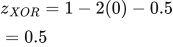 LaTeX:
z_{XOR}=1-2(0)-0.5=0.5Step 6: apply the XOR threshold.
 LaTeX:
y_{XOR}=1Step 7: calculate XNOR output preactivation.
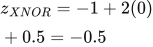 LaTeX:
z_{XNOR}=-1+2(0)+0.5=-0.5Step 8: apply the XNOR threshold.
 LaTeX:
y_{XNOR}=0Verify input (1,0)
Step 1: calculate hidden OR preactivation.
 LaTeX:
z_1=1+0-0.5=0.5Step 2: apply its threshold.
LaTeX: h_1=1Step 3: calculate hidden AND preactivation.
 LaTeX:
z_2=1+0-1.5=-0.5Step 4: apply its threshold.
LaTeX: h_2=0Step 5: calculate XOR output preactivation.
LaTeX: z_{XOR}=1-2(0)-0.5=0.5Step 6: apply the XOR threshold.
LaTeX: y_{XOR}=1Step 7: calculate XNOR output preactivation.
LaTeX: z_{XNOR}=-1+2(0)+0.5=-0.5Step 8: apply the XNOR threshold.
LaTeX: y_{XNOR}=0Verify input (1,1)
Step 1: calculate hidden OR preactivation.
 LaTeX:
z_1=1+1-0.5=1.5Step 2: apply its threshold.
LaTeX: h_1=1Step 3: calculate hidden AND preactivation.
 LaTeX:
z_2=1+1-1.5=0.5Step 4: apply its threshold.
 LaTeX:
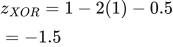
h_2=1Step 5: calculate XOR output preactivation.
 LaTeX:
z_{XOR}=1-2(1)-0.5=-1.5Step 6: apply the XOR threshold.
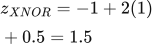
LaTeX: y_{XOR}=0Step 7: calculate XNOR output preactivation.
 LaTeX:
z_{XNOR}=-1+2(1)+0.5=1.5Step 8: apply the XNOR threshold.
LaTeX: y_{XNOR}=1Final answer: XOR = [0,1,1,0]; XNOR = [1,0,0,1] for 00,01,10,11. The hidden nonlinear units make this possible.