Deep Learning · TEE · section
Drill 11 One perceptron learning update
Numerical practice from direct to mixed
Question
Question. Binary perceptron, w = [0,0], b = 0, x = [1,1], target 1, η = 0.5. Use output 1 if z>0 else 0. Perform one update.
Answer — step by step
Given
w = [0,0]; b = 0; x = [1,1]; target t = 1.
Learning rate η = 0.5.
Output 1 only when z > 0; otherwise output 0.
To find
Perform one update and report new weights and bias.
Formula — which one and why
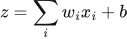
Perceptron learning rule. Evaluate the stated threshold, compare the predicted class with its target, then correct weights and bias. The next sample uses the newly updated parameters.
t = target; o = thresholded output; η = learning rate; xᵢ = input i. Binary and bipolar output conventions must follow the question.
 LaTeX:
z=\sum_iw_ix_i+b LaTeX:
w_i^{\mathrm{new}}=w_i+\eta(t-o)x_i LaTeX:
b^{\mathrm{new}}=b+\eta(t-o)Yaad rakhne ka cue: Prediction nikalo; target−prediction se correction nikalo.
Solution — step by step
Meaning and formula
A perceptron first computes a weighted sum z and then applies the exact threshold rule in the question. This question uses strictly greater than zero, so z = 0 produces output 0.
 LaTeX:
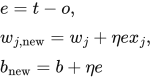
z=w_1x_1+w_2x_2+b,\qquad o=\begin{cases}1&z>0\\0&z\le0\end{cases}The perceptron learning rule uses target minus output, written e below. This is a discrete perceptron rule, not the sigmoid backpropagation derivative.
 LaTeX:
e=t-o,\qquad w_{j,\mathrm{new}}=w_j+\eta e x_j,\qquad b_{\mathrm{new}}=b+\eta eStep 1: obtain the old output
 LaTeX:
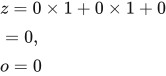
z=0\times1+0\times1+0=0,\qquad o=0Step 2: compare it with the target
 LaTeX:
e=1-0=1Step 3: update each weight separately
 LaTeX:
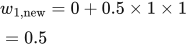
w_{1,\mathrm{new}}=0+0.5\times1\times1=0.5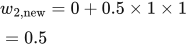 LaTeX:
w_{2,\mathrm{new}}=0+0.5\times1\times1=0.5 LaTeX:
b_{\mathrm{new}}=0+0.5\times1=0.5Step 4: interpret the updated prediction
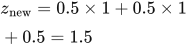 LaTeX:
z_{\mathrm{new}}=0.5\times1+0.5\times1+0.5=1.5Since 1.5 > 0, the new output is 1. Final parameters: w = [0.5, 0.5], b = 0.5.