Deep Learning · TEE · section
Drill 12 XOR using two hidden units
Numerical practice from direct to mixed
Question
Question. Use h1 = step(x1+x2−0.5), h2 = step(x1+x2−1.5), output = step(h1−2h2−0.5), step(z) = 1 if z≥0. Find all four outputs.
Answer — step by step
Given
h₁ = step(x₁+x₂−0.5); h₂ = step(x₁+x₂−1.5).
Output = step(h₁−2h₂−0.5).
step(z) = 1 when z ≥ 0, otherwise 0.
To find
Calculate hidden values and output for 00, 01, 10 and 11.
Formula — which one and why
Threshold logic. Compute the weighted sum for every binary input combination and apply the threshold rule exactly. Hidden neurons can provide separate threshold decisions before the output combines them.
step(z) returns 1 at or above zero unless the question specifies a strict inequality; otherwise it returns 0.
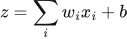 LaTeX:
z=\sum_iw_ix_i+b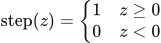 LaTeX:
\operatorname{step}(z)=\begin{cases}1&z\ge0\\0&z<0\end{cases}Yaad rakhne ka cue: Har input row ka sum nikalo, phir threshold lagao.
Solution — step by step
Meaning of the given network
XOR should output 1 when exactly one input is 1, and 0 when the inputs match. The first hidden unit detects “at least one input is 1”; the second detects “both inputs are 1”. The output combines these detections.
 LaTeX:
h_1=\operatorname{step}(x_1+x_2-0.5) LaTeX:
h_2=\operatorname{step}(x_1+x_2-1.5) LaTeX:
o=\operatorname{step}(h_1-2h_2-0.5)For this question, step returns 1 at nonnegative input and 0 at negative input.
Step 1: Input pair 0, 0.
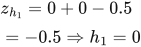 LaTeX:
z_{h_1}=0+0-0.5=-0.5\Rightarrow h_1=0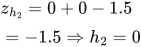 LaTeX:
z_{h_2}=0+0-1.5=-1.5\Rightarrow h_2=0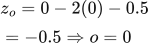 LaTeX:
z_o=0-2(0)-0.5=-0.5\Rightarrow o=0Step 2: Input pair 0, 1.
 LaTeX:
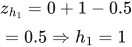
z_{h_1}=0+1-0.5=0.5\Rightarrow h_1=1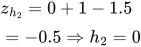 LaTeX:
z_{h_2}=0+1-1.5=-0.5\Rightarrow h_2=0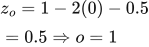 LaTeX:
z_o=1-2(0)-0.5=0.5\Rightarrow o=1Step 3: Input pair 1, 0.
 LaTeX:
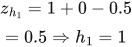
z_{h_1}=1+0-0.5=0.5\Rightarrow h_1=1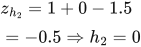 LaTeX:
z_{h_2}=1+0-1.5=-0.5\Rightarrow h_2=0LaTeX: z_o=1-2(0)-0.5=0.5\Rightarrow o=1Step 4: Input pair 1, 1.
 LaTeX:
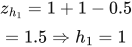
z_{h_1}=1+1-0.5=1.5\Rightarrow h_1=1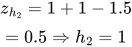 LaTeX:
z_{h_2}=1+1-1.5=0.5\Rightarrow h_2=1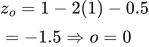 LaTeX:
z_o=1-2(1)-0.5=-1.5\Rightarrow o=0Final truth table: 00 → 0; 01 → 1; 10 → 1; 11 → 0.