Deep Learning · TEE · section
Drill 15 A negative ReLU blocks this path
Numerical practice from direct to mixed
Question
Question. x = 2, w1 = −0.4, b1 = 0.1, w2 = 0.5, b2 = 0.2; hidden ReLU, linear output, y = 1, half squared loss. Find dw 1 and dw 2.
Answer — step by step
Given
x = 2; w₁ = −0.4; b₁ = 0.1; w₂ = 0.5; b₂ = 0.2.
Hidden activation: ReLU; output activation: linear.
Target y = 1; loss: half squared error.
To find
Find the gradients of w₁ and w₂ and explain any zero gradients.
Formula — which one and why
Forward propagation. Evaluate one layer completely before supplying its activated outputs to the next layer. Each layer has its own weights and biases.
x = input vector; h = hidden outputs; W₁,b₁ = hidden parameters; W₂,b₂ = output parameters; f₁,f₂ = the stated activations.
 LaTeX:
z_h=W_1x+b_1 LaTeX:
h=f_1(z_h) LaTeX:
z_o=W_2h+b_2 LaTeX:
o=f_2(z_o)Yaad rakhne ka cue: Pehli layer ka activated output hi agli layer ka input hai.
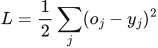
Half summed squared loss. This loss convention takes one-half of the sum of squared prediction errors. Use it when the question specifies it, or explicitly state it as an assumption when the paper omits the loss. Differentiating cancels the factor one-half against the square derivative.
oⱼ = output j; yⱼ = target j; L = half summed squared loss under the stated or explicitly assumed convention.
 LaTeX:
L=\frac12\sum_j(o_j-y_j)^2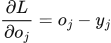 LaTeX:
\frac{\partial L}{\partial o_j}=o_j-y_jYaad rakhne ka cue: Half aur square ka 2 cancel: output derivative = prediction − target.
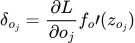
Backpropagation. The loss tells us how each output must change. Multiply by that neuron’s activation slope to obtain its delta. A weight gradient is receiving delta × sending value. Hidden deltas must include every outgoing path.
δ (delta) = derivative of loss with respect to a neuron’s preactivation; f′ = activation derivative; aᵢ = sending activation; Wⱼᵢ = connection weight. Use the exact loss scaling in the question.
 LaTeX:
\delta_{o_j}=\frac{\partial L}{\partial o_j}f_o\prime(z_{o_j})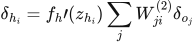 LaTeX:
\delta_{h_i}=f_h\prime(z_{h_i})\sum_jW_{ji}^{(2)}\delta_{o_j}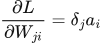 LaTeX:
\frac{\partial L}{\partial W_{ji}}=\delta_ja_i LaTeX:
\frac{\partial L}{\partial b_j}=\delta_j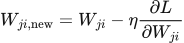 LaTeX:
W_{ji,\mathrm{new}}=W_{ji}-\eta\frac{\partial L}{\partial W_{ji}}Yaad rakhne ka cue: Receiving delta × sending value = us connection ka gradient.
Solution — step by step
Formulas used
The hidden neuron uses ReLU, but the output is linear. “Linear output” means its weighted sum is already its output.
 LaTeX:
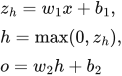
z_h=w_1x+b_1,\quad h=\max(0,z_h),\quad o=w_2h+b_2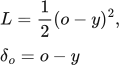 LaTeX:
L=\frac12(o-y)^2,\quad \delta_o=o-y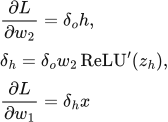 LaTeX:
\frac{\partial L}{\partial w_2}=\delta_o h,\quad \delta_h=\delta_o w_2\operatorname{ReLU}'(z_h),\quad \frac{\partial L}{\partial w_1}=\delta_h xStep 1: hidden weighted sum and activation
 LaTeX:
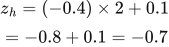
z_h=(-0.4)\times2+0.1=-0.8+0.1=-0.7 LaTeX:
h=\max(0,-0.7)=0Because the raw hidden score is negative, ReLU's derivative at this point is 0.
Step 2: output prediction and output delta
 LaTeX:
o=0.5\times0+0.2=0.2 LaTeX:
\delta_o=0.2-1=-0.8Step 3: output weight gradient
 LaTeX:
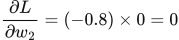
\frac{\partial L}{\partial w_2}=(-0.8)\times0=0This is zero because the input to that connection, h, is zero.
Step 4: hidden delta and input weight gradient
 LaTeX:
\delta_h=(-0.8)\times0.5\times0=0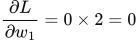 LaTeX:
\frac{\partial L}{\partial w_1}=0\times2=0Final answer: both requested weight gradients are zero. The output bias gradient equals −0.8, so a zero weight gradient does not mean every parameter's gradient is zero.