Deep Learning · TEE · section
Drill 17 Incomplete mini batch
Numerical practice from direct to mixed
Question
Question. N = 103, B = 20, epochs = 3. Count updates for batch GD, SGD, mini-batch keeping the remainder, and mini-batch dropping it.
Answer — step by step
Given
N = 103 samples; B = 20 samples per mini-batch.
E = 3 epochs.
Compare both remainder policies: keep or drop the final 3 examples.
To find
Find total updates for full-batch GD, SGD, and both mini-batch policies.
Formula — which one and why
Number of updates. An update occurs after one processed batch. Full-batch GD uses one batch per epoch; SGD uses one sample per batch. Mini-batches need a stated remainder policy.
N = dataset size; B = batch size; E = number of epochs. Ceiling rounds upward to include a smaller final batch; floor drops it.
 LaTeX:
U_{\mathrm{batch}}=E LaTeX:
U_{\mathrm{SGD}}=EN LaTeX:
U_{\mathrm{keep}}=E\left\lceil\frac NB\right\rceil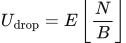 LaTeX:
U_{\mathrm{drop}}=E\left\lfloor\frac NB\right\rfloorYaad rakhne ka cue: Kitne batches process hue, utne updates hue.
Solution — step by step
Meaning and formulas
An epoch means one pass through the dataset. An update happens once per batch used. N is the number of samples, B is the chosen batch size, and E is the number of epochs.
 LaTeX:
U_{\mathrm{batch}}=E,\qquad U_{\mathrm{SGD}}=NE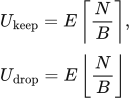 LaTeX:
U_{\mathrm{keep}}=E\left\lceil\frac NB\right\rceil,\qquad U_{\mathrm{drop}}=E\left\lfloor\frac NB\right\rfloorCeiling rounds up to the next integer; floor rounds down. The final incomplete batch needs an update only if it is retained.
Step 1: batch GD
All 103 samples form one batch per epoch.
 LaTeX:
U_{\mathrm{batch}}=3\times1=3Step 2: SGD
Each sample gets its own update.
 LaTeX:
U_{\mathrm{SGD}}=103\times3=309Step 3: mini-batches with the remainder
 LaTeX:
103=5\times20+3The batch sizes are 20, 20, 20, 20, 20 and 3. Six batches per epoch give:
 LaTeX:
U_{\mathrm{keep}}=6\times3=18Step 4: mini-batches without the remainder
Only the five complete batches are used each epoch.
 LaTeX:
U_{\mathrm{drop}}=5\times3=15Final answer: 3, 309, 18 and 15 updates respectively.