Deep Learning · TEE · section
Drill 2 Half sum versus mean
Numerical practice from direct to mixed
Question
Question. Predictions = [0.2,0.7,0.4], targets = [0,1,1]. Find SSE, half SSE and MSE.
Answer — step by step
Given
Predictions = [0.2, 0.7, 0.4].
Targets = [0, 1, 1]; number of outputs n = 3.
To find
Find SSE, half SSE, MSE and the prediction gradients requested in the question.
Formula — which one and why
Squared-error objectives. Calculate signed errors first and square them. SSE adds the squares; half SSE divides that sum by 2; MSE divides by the number of scalar predictions. These denominators are different conventions.
ŷᵢ = prediction; yᵢ = target; eᵢ = signed error; n = number of scalar predictions included in the stated loss.
 LaTeX:
e_i=\hat y_i-y_i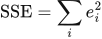 LaTeX:
\mathrm{SSE}=\sum_i e_i^2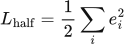 LaTeX:
L_{\mathrm{half}}=\frac12\sum_i e_i^2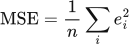 LaTeX:
\mathrm{MSE}=\frac1n\sum_i e_i^2Yaad rakhne ka cue: Pehle error square; phir question ke hisaab se sum, half ya mean.
Solution — step by step
Given values and loss definitions
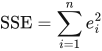
There are n = 3 prediction–target pairs. Use the supplied predictions directly; no rounding to class labels is required. Let eᵢ = ŷᵢ − yᵢ be the signed residual for pair i.
 LaTeX:
\mathrm{SSE}=\sum_{i=1}^{n}e_i^2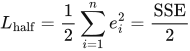 LaTeX:
L_{\mathrm{half}}=\frac12\sum_{i=1}^{n}e_i^2=\frac{\mathrm{SSE}}2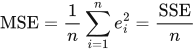 LaTeX:
\mathrm{MSE}=\frac1n\sum_{i=1}^{n}e_i^2=\frac{\mathrm{SSE}}nSSE is the sum of squared errors. Half SSE and MSE rescale that same sum by different denominators: 2 and n, respectively.
Step 1: calculate each residual and its square
| Pair | Prediction ŷᵢ | Target yᵢ | Residual ŷᵢ − yᵢ | Squared residual |
|---|---|---|---|---|
| 1 | 0.2 | 0 | 0.2 − 0 = 0.2 | (0.2)² = 0.04 |
| 2 | 0.7 | 1 | 0.7 − 1 = −0.3 | (−0.3)² = 0.09 |
| 3 | 0.4 | 1 | 0.4 − 1 = −0.6 | (−0.6)² = 0.36 |
Step 2: sum the squared residuals
 LaTeX:
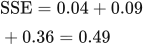
\mathrm{SSE}=0.04+0.09+0.36=0.49Square each residual before summing. Squaring the sum of signed residuals would be a different quantity, because positive and negative residuals could cancel.
Step 3: apply each requested normalization
For half SSE, the denominator is 2:
 LaTeX:
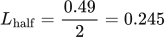
L_{\mathrm{half}}=\frac{0.49}{2}=0.245For MSE, the denominator is the number of pairs, n = 3:
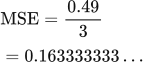 LaTeX:
\mathrm{MSE}=\frac{0.49}{3}=0.163333333\ldotsFinal answer: SSE = 0.49; half SSE = 0.245; MSE ≈ 0.163333. They represent the same residuals at different scales. Half SSE and MSE coincide when n = 2; they do not coincide for these three nonzero residuals. No derivative is required by this question.