Deep Learning · TEE · section
Drill 21 Momentum variation 2
Numerical practice from direct to mixed
Question
Question. J(θ) = ½(θ−1)², θ₀ = -0.5, η = 0.1. Perform two Momentum updates. Use β = 0.9, v₀ = 0 and signed velocity.
Answer — step by step
Given
Objective: J(θ) = ½(θ−1)².
Initial θ₀ = −0.5; η = 0.1; two iterations.
β = 0.9; initial signed velocity v₀ = 0.
To find
Find every stored state needed by the method and the parameter after each of two updates.
Formula — which one and why
Momentum with signed velocity. Combine the retained old displacement with the current downhill correction, then add that signed displacement to the old parameter.
v = signed velocity/displacement; β = momentum coefficient; g = current gradient; η = learning rate. This convention uses +v in the parameter update.
 LaTeX:
v_t=\beta v_{t-1}-\eta g_t LaTeX:
\theta_t=\theta_{t-1}+v_tYaad rakhne ka cue: Pehle velocity banao; phir old parameter mein velocity jodo.
Solution — step by step
Meaning of the symbols
θ (theta) is the number we update. η (eta) is learning rate 0.1. g is the derivative of the objective, evaluated at the required position. A subscript counts updates; θ₀ means the starting value.
Differentiate the objective first
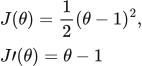 LaTeX:
J(\theta)=\frac12(\theta-1)^2,\qquad J\prime(\theta)=\theta-1The power rule brings down 2, which cancels the half. The inside derivative is 1, so the remaining gradient is θ minus 1.
Update formulas
v stores the signed movement from the previous update. β = 0.9 retains 90% of that movement. Start v₀ = 0.
 LaTeX:
g_t=J\prime(\theta_{t-1})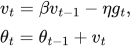 LaTeX:
v_t=\beta v_{t-1}-\eta g_t,\quad \theta_t=\theta_{t-1}+v_tStep 1: Update 1.
 LaTeX:
g_1=-0.5-(1)=-1.5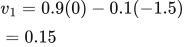 LaTeX:
v_1=0.9(0)-0.1(-1.5)=0.15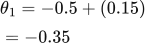 LaTeX:
\theta_1=-0.5+(0.15)=-0.35Step 2: Update 2.
 LaTeX:
g_2=-0.35-(1)=-1.35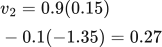 LaTeX:
v_2=0.9(0.15)-0.1(-1.35)=0.27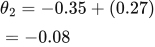 LaTeX:
\theta_2=-0.35+(0.27)=-0.08Final parameter after two updates: -0.08. The second gradient is evaluated again using the parameter obtained after the first update.