Deep Learning · TEE · section
Drill 37 Complete small CNN
Numerical practice from direct to mixed
Question
Question. Input 10 × 10 × 1 → Conv 3 × 3,4 filters, stride 1, valid → Pool 2 stride 2 → Flatten → Dense 3. Find all shapes and parameters.
Answer — step by step
Given
Input = 10 × 10 × 1.
Conv: 3 × 3, 4 filters, stride 1, valid padding.
Pool: 2 × 2, stride 2; then flatten and dense layer with 3 outputs.
Include one bias per filter/dense neuron.
To find
Find all output shapes, layer parameter counts and their sum.
Formula — which one and why
Complete CNN calculation. Carry each output shape into the next layer. Convolution changes spatial size and channel count; pooling changes spatial size; flattening converts all activations into dense-layer inputs.
H,W,C = feature-map height, width and channels; K = kernel size; S = stride; P_pad = padding. One bias is assumed for each learned filter or dense neuron unless specified otherwise.
 LaTeX:
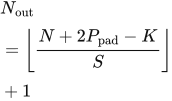
N_{\mathrm{out}}=\left\lfloor\frac{N+2P_{\mathrm{pad}}-K}{S}\right\rfloor+1 LaTeX:
P_{\mathrm{conv}}=(K^2C_{\mathrm{in}}+1)C_{\mathrm{out}} LaTeX:
n_{\mathrm{flat}}=HWC LaTeX:
P_{\mathrm{dense}}=(n_{\mathrm{in}}+1)n_{\mathrm{out}} LaTeX:
P_{\mathrm{pool}}=P_{\mathrm{flatten}}=0Yaad rakhne ka cue: Ek layer ka output, next layer ka input; shape aur parameters alag count.
Solution — step by step
Formulas and assumptions
“Valid” means zero padding. The convolution and dense layers each have one bias per receiving filter or neuron. Pooling and flattening have no learned parameters.
 LaTeX:
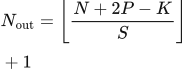
N_{\mathrm{out}}=\left\lfloor\frac{N+2P-K}{S}\right\rfloor+1LaTeX: P_{\mathrm{conv}}=(K^2C_{\mathrm{in}}+1)C_{\mathrm{out}}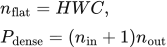 LaTeX:
n_{\mathrm{flat}}=HWC,\qquad P_{\mathrm{dense}}=(n_{\mathrm{in}}+1)n_{\mathrm{out}}Step 1: convolution shape
 LaTeX:
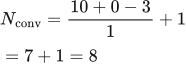
N_{\mathrm{conv}}=\frac{10+0-3}{1}+1=7+1=8Four filters produce four channels: 8 × 8 × 4.
Step 2: convolution parameters
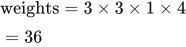 LaTeX:
\text{weights}=3\times3\times1\times4=36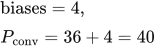 LaTeX:
\text{biases}=4,\qquad P_{\mathrm{conv}}=36+4=40Step 3: pooling shape
Pooling now receives size 8, not the original size 10.
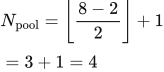 LaTeX:
N_{\mathrm{pool}}=\left\lfloor\frac{8-2}{2}\right\rfloor+1=3+1=4Channels remain 4: 4 × 4 × 4. Pooling parameters = 0.
Step 4: flatten
 LaTeX:
n_{\mathrm{flat}}=4\times4\times4=64Flatten creates a vector of 64 numbers. It rearranges values, so its parameter count is 0.
Step 5: dense layer with 3 outputs
 LaTeX:
\text{weights}=64\times3=192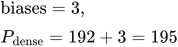 LaTeX:
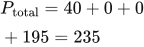
\text{biases}=3,\qquad P_{\mathrm{dense}}=192+3=195Step 6: add learned parameters
 LaTeX:
P_{\mathrm{total}}=40+0+0+195=235Final answer: shapes 8 × 8 × 4 → 4 × 4 × 4 → 64 → 3; total 235 parameters.