Deep Learning · TEE · section
Drill 43 Calculate gates before the cell
Numerical practice from direct to mixed
Question
Question. Gate preactivations zf = zi = zo = 0, candidate preactivation 0.5, Cprevious = 0.2. Find gates, C, h.
Answer — step by step
Given
Raw gate scores: zf = zi = zo = 0.
Raw candidate score = 0.5; old cell C = 0.2.
To find
Activate gates/candidate, then calculate the new cell and hidden state.
Formula — which one and why
Activate raw gate scores first. A preactivation is an unprocessed score. Convert forget/input/output scores with sigmoid and candidate scores with tanh before using the cell-update equations.
z_f,z_i,z_o = gate preactivations; z_c = candidate preactivation. An already activated gate must not be passed through sigmoid again.
 LaTeX:
f=\sigma(z_f),\quad i=\sigma(z_i),\quad o=\sigma(z_o)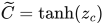 LaTeX:
\widetilde C=\tanh(z_c)Yaad rakhne ka cue: Raw score pehle activate; activated gate ko dobara sigmoid nahi.
LSTM cell and hidden state. Multiply old memory by the forget gate; multiply candidate content by the input gate; add those two contributions. Apply tanh to the new cell and multiply by the output gate.
f,i,o = activated forget/input/output gates; C_old = previous cell; C_tilde = candidate content; C = new cell; h = visible hidden state. ⊙ means elementwise multiplication.
 LaTeX:
C=f\odot C_{\mathrm{old}}+i\odot\widetilde C LaTeX:
h=o\odot\tanh CYaad rakhne ka cue: Purana rakho + naya lo; phir tanh aur output gate.
Solution — step by step
Meaning and formulas
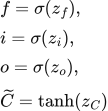
The question supplies raw gate scores, called preactivations. Convert them to gates using sigmoid first. Convert the candidate's score using tanh.
 LaTeX:
f=\sigma(z_f),\quad i=\sigma(z_i),\quad o=\sigma(z_o),\quad \widetilde C=\tanh(z_C)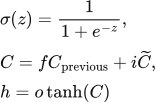 LaTeX:
\sigma(z)=\frac1{1+e^{-z}},\quad C=fC_{\mathrm{previous}}+i\widetilde C,\quad h=o\tanh(C)Step 1: turn each zero score into a gate
 LaTeX:
\sigma(0)=\frac1{1+e^0}=\frac12=0.5Thus f = i = o = 0.5. A zero score is not a zero gate.
Step 2: calculate candidate content
 LaTeX:
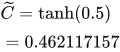
\widetilde C=\tanh(0.5)=0.462117157Step 3: combine retained memory and new content
 LaTeX:
fC_{\mathrm{previous}}=0.5\times0.2=0.1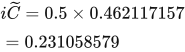 LaTeX:
i\widetilde C=0.5\times0.462117157=0.231058579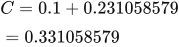 LaTeX:
C=0.1+0.231058579=0.331058579Step 4: compute the visible hidden state
 LaTeX:
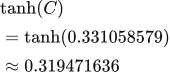
\tanh(C)=\tanh(0.331058579)\approx0.319471636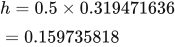 LaTeX:
h=0.5\times0.319471636=0.159735818Final answer: gates 0.5 each; candidate ≈ 0.462117157; C ≈ 0.331058579; h ≈ 0.159735818.