Deep Learning · TEE · section
Drill 44 GRU reset then mix
Numerical practice from direct to mixed
Question
Question. hprevious = 0.4, r = 0.5, z = 0.25, x = 1, W = 0.2, U = 0.5, b = 0. Use candidate = tanh(Wx+U(r × hprevious)) and h = (1−z) hprevious+z candidate.
Answer — step by step
Given
Old hidden state = 0.4; reset r = 0.5; update z = 0.25.
x = 1; W = 0.2; U = 0.5; b = 0.
Use h = (1−z)h_old + z×candidate.
To find
Find reset contribution, candidate and new hidden state.
Formula — which one and why
GRU reset and state mixture. The reset gate controls old-state information entering the candidate. The stated update convention then mixes the original old state and the candidate.
r = reset gate; z = update gate; h_old = previous state; h_tilde = candidate. Here z weights the candidate; some questions instead define z to weight the old state.
 LaTeX:
\widetilde h=\tanh(Wx+U(r\odot h_{\mathrm{old}})+b) LaTeX:
h=(1-z)\odot h_{\mathrm{old}}+z\odot\widetilde hYaad rakhne ka cue: Reset candidate ko control; update gate old-new mixture ko control.
Solution — step by step
Meaning and given convention
The reset gate r scales the old state while making the candidate. The update gate z controls the amount of candidate used in the final mixture under this question's convention. Some books reverse the roles of z and 1 − z, so copy the supplied formula.
 LaTeX:
\widetilde h=\tanh\left(Wx+U(rh_{\mathrm{previous}})+b\right) LaTeX:
h=(1-z)h_{\mathrm{previous}}+z\widetilde hStep 1: reset the old state for candidate construction
 LaTeX:
rh_{\mathrm{previous}}=0.5\times0.4=0.2Step 2: form the candidate's raw score
 LaTeX:
Wx=0.2\times1=0.2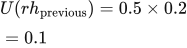 LaTeX:
U(rh_{\mathrm{previous}})=0.5\times0.2=0.1 LaTeX:
a=0.2+0.1+0=0.3Step 3: apply tanh
 LaTeX:
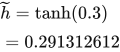
\widetilde h=\tanh(0.3)=0.291312612Step 4: mix the original old state with the candidate
 LaTeX:
1-z=1-0.25=0.75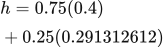 LaTeX:
h=0.75(0.4)+0.25(0.291312612)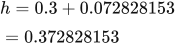 LaTeX:
h=0.3+0.072828153=0.372828153Final answer: h ≈ 0.372828153. The final old-state term uses 0.4, not the reset value 0.2.