Deep Learning · TEE · section
Drill 45 BPTT shared weights
Numerical practice from direct to mixed
Question
Question. Linear recurrence hₜ = uxₜ+vhₜ₋₁+b, output h₂, target 1, half squared loss. u = 0.2, v = 0.5, b = 0, h₀ = 0, x₁ = 1, x₂ = 2, η = 0.1. Find both states and one update.
Answer — step by step
Given
Linear recurrence hₜ = uxₜ+vhₜ₋₁+b.
u = 0.2; v = 0.5; b = 0; h₀ = 0.
x₁ = 1; x₂ = 2; target for h₂ = 1.
Half squared loss; learning rate η = 0.1.
To find
Find both states, all three shared-parameter gradients and one simultaneous update.
Formula — which one and why
Backpropagation through time. Unroll the recurrence, send the loss derivative backward through its links and add contributions for each shared parameter before updating it once.
For h_t=ux_t+vh_(t−1)+b with loss only at the last state: δ_t = loss derivative at that state. The linear recurrence has activation slope 1.
 LaTeX:
\delta_T=h_T-y LaTeX:
\delta_t=v\delta_{t+1}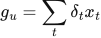 LaTeX:
g_u=\sum_t\delta_tx_t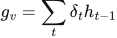 LaTeX:
g_v=\sum_t\delta_th_{t-1} LaTeX:
g_b=\sum_t\delta_tYaad rakhne ka cue: Time ke har use ka gradient jodo; shared weight ko ek baar update karo.
Gradient descent. Evaluate the gradient at the current parameter, multiply by the learning rate and subtract. If the objective is supplied, differentiate it and recompute the gradient after each update.
θ (theta) = trainable parameter; g = derivative of the stated objective J; η = learning rate; t labels the update number.
 LaTeX:
g_t=J\prime(\theta_{t-1}) LaTeX:
\theta_t=\theta_{t-1}-\eta g_tYaad rakhne ka cue: Naya = purana − learning rate × current gradient.
Solution — step by step
Meaning and formulas
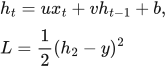
The same u, v and b appear at both times. u multiplies the input, v multiplies the previous state, and b is a shared bias. The loss is only at the final state h₂. Because the recurrence is linear, its local activation derivative is 1.
 LaTeX:
h_t=ux_t+vh_{t-1}+b,\qquad L=\frac12(h_2-y)^2 LaTeX:
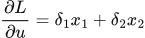
\delta_2=h_2-y,\qquad \delta_1=v\delta_2Each shared parameter receives a contribution from both of its uses.
 LaTeX:
\frac{\partial L}{\partial u}=\delta_1x_1+\delta_2x_2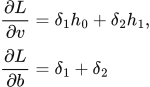 LaTeX:
\frac{\partial L}{\partial v}=\delta_1h_0+\delta_2h_1,\qquad \frac{\partial L}{\partial b}=\delta_1+\delta_2Step 1: forward through time 1
 LaTeX:
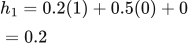
h_1=0.2(1)+0.5(0)+0=0.2Step 2: forward through time 2
 LaTeX:
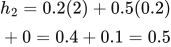
h_2=0.2(2)+0.5(0.2)+0=0.4+0.1=0.5 LaTeX:
L=\frac12(0.5-1)^2=0.125Step 3: carry the gradient backwards
 LaTeX:
\delta_2=0.5-1=-0.5 LaTeX:
\delta_1=0.5(-0.5)=-0.25Step 4: add contributions for each shared parameter
 LaTeX:
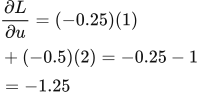
\frac{\partial L}{\partial u}=(-0.25)(1)+(-0.5)(2)=-0.25-1=-1.25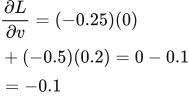 LaTeX:
\frac{\partial L}{\partial v}=(-0.25)(0)+(-0.5)(0.2)=0-0.1=-0.1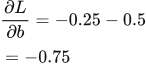 LaTeX:
\frac{\partial L}{\partial b}=-0.25-0.5=-0.75Step 5: update once after summing
 LaTeX:
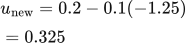
u_{\mathrm{new}}=0.2-0.1(-1.25)=0.325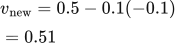 LaTeX:
v_{\mathrm{new}}=0.5-0.1(-0.1)=0.51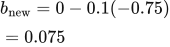 LaTeX:
b_{\mathrm{new}}=0-0.1(-0.75)=0.075Final answer: states 0.2 and 0.5; new parameters u = 0.325, v = 0.51, b = 0.075.