Deep Learning · TEE · section
Drill 8 Activation contrast
Numerical practice from direct to mixed
Question
Question. For z = [−3,0,2], find ReLU and Leaky ReLU with α = 0.1, and the sigmoid derivative at z = 0.
Answer — step by step
Given
Inputs z = [−3,0,2].
Leaky-ReLU negative slope α = 0.1.
For the sigmoid derivative, use z = 0.
To find
Find ReLU and Leaky-ReLU outputs and the sigmoid slope at zero.
Formula — which one and why
ReLU and Leaky ReLU. ReLU returns zero for negative input and retains positive input. Leaky ReLU instead multiplies a negative input by its supplied slope.
z = preactivation; α (alpha) = supplied negative-side slope for Leaky ReLU. The derivative at zero needs an explicit convention.
 LaTeX:
\operatorname{ReLU}(z)=\max(0,z) LaTeX:
\operatorname{LeakyReLU}(z)=\begin{cases}z&z\ge0\\\alpha z&z<0\end{cases}Yaad rakhne ka cue: Positive ko rehne do; negative ko zero. Leaky mein chhota negative rehne do.
Sigmoid and its slope. Use sigmoid when the neuron is specified to squash its preactivation into (0,1). Once its output is known, its derivative needs only output × (1−output).
z = preactivation; p = sigmoid output; e is the exponential base, not a prediction error in this formula.
 LaTeX:
p=\frac{1}{1+e^{-z}}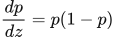 LaTeX:
\frac{dp}{dz}=p(1-p)Yaad rakhne ka cue: Sigmoid output p; uska slope p × (1−p).
Solution — step by step
Formulas and their meanings
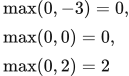
ReLU compares the input with zero and returns the larger value.
LaTeX: \operatorname{ReLU}(z)=\max(0,z)Leaky ReLU uses the input unchanged when nonnegative, and multiplies it by α when negative.
LaTeX: \operatorname{LeakyReLU}(z)=\begin{cases}z&z\ge0\\\alpha z&z<0\end{cases}Step 1: apply ReLU separately to all three inputs
 LaTeX:
\max(0,-3)=0,\quad \max(0,0)=0,\quad \max(0,2)=2ReLU output = [0, 0, 2].
Step 2: use α = 0.1 only on the negative input
 LaTeX:
0.1\times(-3)=-0.3The zero and positive entries remain 0 and 2. Leaky ReLU output = [−0.3, 0, 2].
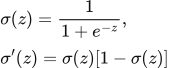
Step 3: calculate sigmoid before its derivative
 LaTeX:
\sigma(z)=\frac1{1+e^{-z}},\qquad \sigma'(z)=\sigma(z)[1-\sigma(z)]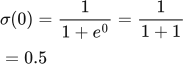 LaTeX:
\sigma(0)=\frac1{1+e^0}=\frac1{1+1}=0.5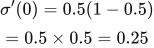 LaTeX:
\sigma'(0)=0.5(1-0.5)=0.5\times0.5=0.25The sigmoid value is 0.5 but its slope is 0.25. They are different quantities.