Deep Learning · TEE · section
Negative numbers are direction
Mathematics revision
1. The minus sign can describe a number
Zero is the reference point. Positive numbers such as 1, 2 and 3 lie to its right on a number line. Negative numbers such as −1, −2 and −3 lie to its left. The number −3 is three units below zero; it is not an instruction to subtract until another number is supplied.
In 5 − 2, the minus sign is an operation: subtract 2 from 5. In 5 + (−2), the sign inside the brackets belongs to the number negative 2. Both expressions finish at 3. Brackets keep the signed number together.
2. Adding a negative moves left
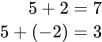
Start at 5. Adding positive 2 moves two places right, to 7. Adding negative 2 moves two places left, to 3.
 LaTeX:
\begin{aligned}5+2&=7\\5+(-2)&=3\end{aligned}If both numbers are negative, keep moving left. Start at −3 and add −2: the answer is −5.
 LaTeX:
(-3)+(-2)=-53. Subtracting reverses that movement
Subtracting positive 2 moves left. Subtracting negative 2 reverses a leftward movement, so it moves right. A money example is removing a debt of 2: your balance increases by 2.
 LaTeX:
5-(-2)=5+2=7The shortcut “two negatives make a positive” is not a rule for every calculation. Negative 3 plus negative 2 is still −5. First identify the operation: addition, subtraction, multiplication or division.
4. Multiplication has its own sign rule
For multiplication and division, equal signs give a positive result and different signs give a negative result. Calculate the ordinary size, then attach the correct sign.
| Signs being multiplied | Complete calculation | Result sign |
|---|---|---|
| Positive × positive | 3 × 2 = 6 | Positive |
| Negative × positive | (−3) × 2 = −6 | Negative |
| Positive × negative | 3 × (−2) = −6 | Negative |
| Negative × negative | (−3) × (−2) = 6 | Positive |
Division uses the same sign pattern: (−6) ÷ 2 = −3 and (−6) ÷ (−2) = 3. The divisor must be nonzero.
5. Fully worked arithmetic
Question. Calculate −3 + 2, −3 − 2 and −3 − (−2).
Answer — step by step.
Given
Expressions: −3+2; −3−2; −3−(−2).
To find
Evaluate the three signed-number expressions.
Formula — which one and why
Order of operations. Grouping decides which operation is performed first. Evaluate brackets, then powers, then multiplication/division, then addition/subtraction.
A minus sign inside brackets belongs to that number. Subtracting a negative changes the operation to addition.
 LaTeX:
a-(-b)=a+bYaad rakhne ka cue: Bracket pehle; phir power; phir multiply/divide; aakhir mein plus-minus.
Solution — step by step
Step 1: evaluate the first expression. start at −3 and move two places right. The answer is −1.
 LaTeX:
-3+2=-1Step 2: evaluate the second expression. start at −3 and move two places left. The answer is −5.
 LaTeX:
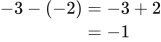
-3-2=-5Step 3: evaluate the third expression. replace subtract-negative-2 with add-positive-2. The answer is −1.
 LaTeX:
\begin{aligned}-3-(-2)&=-3+2\\&=-1\end{aligned}Later, a weight update subtracts a correction that can itself be negative. The third expression explains exactly why that update can increase a weight.