Deep Learning · TEE · section
R25 Q5b · ReLU RNN state with declared orientation
February 2025 re-exam · complete solved paper
Question
Question. Sketch a one-hidden-layer RNN and state its hidden-state formula. Compute hₜ for Wxh=[[0.2,0.4],[0.1,0.3]], Whh=[[0.5,0.6],[0.3,0.4]], b=[0.1,0.2], x=[1,0], previoush=[0,1], ReLU. (10 marks)
Answer — step by step
Given
Input-to-hidden weight matrix Wₓₕ: transforms the two current input values into contributions to the two hidden units.
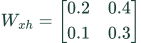 LaTeX:
W_{xh}=\begin{bmatrix}0.2&0.4\\0.1&0.3\end{bmatrix}Hidden-to-hidden weight matrix Wₕₕ: transforms the two previous hidden activations into recurrent contributions.
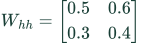 LaTeX:
W_{hh}=\begin{bmatrix}0.5&0.6\\0.3&0.4\end{bmatrix}| Quantity | Given value | Meaning |
|---|---|---|
| xₜ | [1, 0] | Current input row: two input values |
| hₜ₋₁ | [0, 1] | Previous hidden-state row: two stored activations |
| b | [0.1, 0.2] | One bias for each hidden unit |
| Activation | ReLU(z) = max(0, z) | Apply separately to each hidden weighted sum |
To find
Sketch the one-hidden-layer RNN, state its recurrence, and calculate the two components of hₜ.
Formula: which one and why
The printed vectors are horizontal and the weight-index convention is not specified. Adopt row vectors multiplied on the right:
 LaTeX:
h_t=\operatorname{ReLU}(x_tW_{xh}+h_{t-1}W_{hh}+b)Step 1. Multiply the input row
[1,0]Wxh=[1×0.2+0×0.1,1×0.4+0×0.3]=[0.2,0.4].
Step 2. Multiply the previous-state row
[0,1]Whh=[0×0.5+1×0.3,0×0.6+1×0.4]=[0.3,0.4].
Step 3. Add componentwise including bias
[0.2+0.3+0.1,0.4+0.4+0.2]=[0.6,1.0].
Step 4. Apply ReLU separately
[max(0,0.6),max(0,1.0)]=[0.6,1.0].
Final answer
Row-vector convention: hₜ=[0.6,1.0]. If the supplied matrices instead map column inputs by Wxh x + Whh h +b, the untransposed arrays give[0.9,0.7]. That is a different orientation; explicitly state the formula. Transposing the matrices when switching convention preserves the same network.
Source / convention note. Square matrices and printed horizontal vectors leave orientation ambiguous; both possible readings are explained, main answer follows row-vector form.