Deep Learning · TEE · section
Mean, variance and standard deviation from ordinary arithmetic
The maths behind a network
Definition. The arithmetic mean measures the centre of a numerical dataset. Variance measures the average squared deviation from that mean, and standard deviation expresses dispersion in the original units.
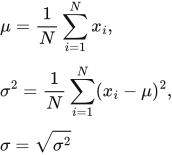 LaTeX:
\mu=\frac{1}{N}\sum_{i=1}^{N}x_i,\qquad \sigma^2=\frac{1}{N}\sum_{i=1}^{N}(x_i-\mu)^2,\qquad \sigma=\sqrt{\sigma^2}These are population formulas, or empirical moments treating the supplied dataset as the complete reference set. An unbiased sample-variance estimate instead divides the squared-deviation sum by N−1. Use the convention specified by the question; the two denominators are not interchangeable.
Question. Find the population mean, variance and standard deviation of [3, 3, 7, 7].
Given
Observations = [3,3,7,7]; N = 4.
Use population variance (divide by N).
To find
Find the population mean μ, variance σ² and standard deviation σ.
Formula — which one and why
Mean and spread. The mean is the sum divided by the number of values. Population variance averages squared distances from that mean; standard deviation is its square root.
N = number of values; xᵢ = value i; μ = mean; σ² = variance; σ = standard deviation. Σ means add the indicated terms.
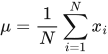 LaTeX:
\mu=\frac{1}{N}\sum_{i=1}^{N}x_i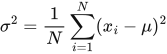 LaTeX:
\sigma^2=\frac{1}{N}\sum_{i=1}^{N}(x_i-\mu)^2 LaTeX:
\sigma=\sqrt{\sigma^2}Yaad rakhne ka cue: Mean = sabka total ÷ count; variance = squared distances ka mean.
Solution — step by step
Step 1: add all four observations.
 LaTeX:
3+3+7+7=20Step 2: divide by the count to obtain the mean.
 LaTeX:
\mu=\frac{20}{4}=5Step 3: subtract the mean from each observation.
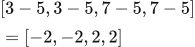 LaTeX:
[3-5,3-5,7-5,7-5]=[-2,-2,2,2]Step 4: square each deviation.
 LaTeX:
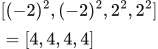
[(-2)^2,(-2)^2,2^2,2^2]=[4,4,4,4]Step 5: add the squared deviations.
 LaTeX:
4+4+4+4=16Step 6: divide by four for population variance.
 LaTeX:
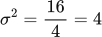
\sigma^2=\frac{16}{4}=4Step 7: take the nonnegative square root.
 LaTeX:
\sigma=\sqrt4=2Answer: mean = 5, population variance = 4 and population standard deviation = 2. Variance has squared units; standard deviation has the same units as the observations. With the sample convention, the variance would instead be 16/3.