Deep Learning · TEE · section
Chain rule: the complete calculation
The maths behind a network
When one value depends on another, a change passes through both calculations. The total derivative multiplies the two local derivatives. It does not add them. Here w is the number being changed, z is an intermediate value, and L is the final value.
Let z = 3w + 1 and L = z². We will calculate the derivative of L with respect to w at w = 1.
Step 1: find the intermediate value. Replace w by 1: z = 3 × 1 + 1 = 4.
Step 2: differentiate the last calculation. For L = z², the power rule gives dL/dz = 2z. At z = 4, this is 2 × 4 = 8. This measures how L responds to z.
Step 3: differentiate the first calculation. For z = 3w + 1, the derivative of 3w is 3 and the derivative of the constant 1 is 0. Therefore dz/dw = 3. This measures how z responds to w.
Step 4: connect the two effects. Multiply 8 by 3. The final derivative is 24.
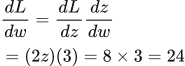 LaTeX:
\frac{dL}{dw}=\frac{dL}{dz}\frac{dz}{dw}=(2z)(3)=8\times3=24The function value is L = 4² = 16. The derivative is 24. These have different meanings: 16 is the current value of L; 24 is its local rate of change per unit change in w.