Deep Learning · TEE · section
More outputs and vectorized backpropagation
Neural-network foundations
Definition. Vectorized backpropagation expresses the chain rule using matrix products and elementwise derivatives. When a hidden activation affects several outputs, its derivative contains the sum of the contributions from every downstream path.
Why the hidden derivative is a sum
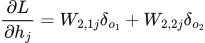
If hidden activation hⱼ connects to output preactivations zₒ₁ and zₒ₂, changing hⱼ changes both outputs. The multivariable chain rule gives:
 LaTeX:
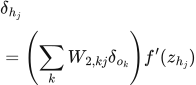
\frac{\partial L}{\partial h_j}=W_{2,1j}\delta_{o_1}+W_{2,2j}\delta_{o_2}For any number of connected outputs, sum their contributions and then differentiate the hidden activation:
 LaTeX:
\delta_{h_j}=\left(\sum_k W_{2,kj}\delta_{o_k}\right)f'(z_{h_j})Use the connecting weights from the original forward pass. Adding only the contribution of the first output would omit a dependency of the loss.
Matrix equations for one training sample
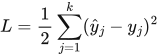
Use column vectors throughout. Let W₁ map d inputs to m hidden units and W₂ map those units to k outputs. The following output-delta formula assumes half sum of squared errors and an elementwise output activation f₂:
 LaTeX:
L=\frac12\sum_{j=1}^{k}(\hat y_j-y_j)^2 LaTeX:
\delta_2=(\hat y-y)\odot f_2'(z_2)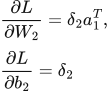 LaTeX:
\frac{\partial L}{\partial W_2}=\delta_2a_1^T,\qquad\frac{\partial L}{\partial b_2}=\delta_2 LaTeX:
\delta_1=(W_2^T\delta_2)\odot f_1'(z_1)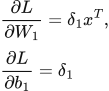 LaTeX:
\frac{\partial L}{\partial W_1}=\delta_1x^T,\qquad\frac{\partial L}{\partial b_1}=\delta_1Here ⊙ means elementwise multiplication. The product δ₂a₁ᵀ is an outer product: every receiving delta is multiplied by every sending activation.
| Quantity | Shape | Reason |
|---|---|---|
| W₁ and its gradient | m × d | m receiving hidden neurons, d inputs |
| W₂ and its gradient | k × m | k receiving output neurons, m hidden activations |
| δ₂ | k × 1 | One derivative per output preactivation |
| W₂ᵀδ₂ | m × 1 | The summed downstream derivative for each hidden unit |
| δ₂a₁ᵀ | (k × 1)(1 × m) = k × m | The output-weight gradient has the same shape as W₂ |
How the loss changes the output delta
For MSE averaged over k output components, the squared-error derivative has the factor 2/k. For sigmoid with binary cross-entropy, or softmax with categorical cross-entropy and a normalized target, the paired derivative simplifies to prediction minus target:
 LaTeX:
\delta_{\mathrm{output}}=\hat y-yThat simplification already includes differentiation of the paired activation and loss. Multiplying by a sigmoid derivative again would be incorrect. For sigmoid with half squared error, the sigmoid derivative is still required.
For a batch, sum per-example parameter gradients; divide by the batch size only if the objective is a batch mean. State the output reduction and batch reduction separately when both appear in a question.