Deep Learning · TEE · section
Biological neurons and the McCulloch-Pitts model
Neural-network foundations
Definition. An artificial neuron is a simplified computational model inspired by the collection, combination and transmission of signals in biological neurons. This analogy motivates weighted inputs and an output response; it is not a full simulation of a living neuron.
Biological and artificial components
| Biological component | Simplified artificial counterpart | Function in the analogy |
|---|---|---|
| Dendrites | Input connections | Receive incoming signals |
| Synapses | Connection weights | Influence how strongly each incoming signal contributes |
| Cell body or soma | Aggregation stage | Combines the weighted signals |
| Firing behavior | Threshold or activation function | Determines the model's output response |
| Axon | Output connection | Passes the resulting signal onward |
For an artificial threshold unit, a threshold θ on the weighted sum can be written as a bias b = −θ, followed by a threshold at zero. The equality convention must be preserved.
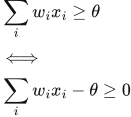 LaTeX:
\sum_i w_ix_i\ge\theta\quad\Longleftrightarrow\quad\sum_i w_ix_i-\theta\ge0McCulloch–Pitts model and perceptron
The McCulloch–Pitts model is an early binary threshold model. Its logical connections and threshold are prescribed to implement a desired behavior; it has no data-driven weight-update procedure. The original formulation also distinguishes excitatory inputs from inhibitory inputs, which can prevent firing. In elementary logic-gate examples using only excitatory inputs, a threshold on their sum is sufficient.
A perceptron introduces adjustable connection weights and a learning rule. It calculates a weighted sum, applies a threshold and updates parameters when its classification disagrees with the target. Both single threshold units have a linear decision boundary; neither single unit solves XOR in the original two-input space.
Question. Implement AND and OR for binary inputs x₁, x₂ using the sum x₁ + x₂ and output 1 when the sum is at least θ. Use θ = 2 for AND and θ = 1 for OR.
Given
Implement AND and OR for binary inputs x₁, x₂ using the sum x₁ + x₂ and output 1 when the sum is at least θ.
Use θ = 2 for AND and θ = 1 for OR.
To find
Write every row of the truth table and the requested network output.
Formula — which one and why
Threshold logic. Compute the weighted sum for every binary input combination and apply the threshold rule exactly. Hidden neurons can provide separate threshold decisions before the output combines them.
step(z) returns 1 at or above zero unless the question specifies a strict inequality; otherwise it returns 0.
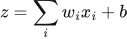 LaTeX:
z=\sum_iw_ix_i+b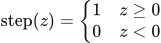 LaTeX:
\operatorname{step}(z)=\begin{cases}1&z\ge0\\0&z<0\end{cases}Yaad rakhne ka cue: Har input row ka sum nikalo, phir threshold lagao.
Solution — step by step
Calculate the sum once for each input pair, then compare it with the relevant threshold.
Binary input (0,0)
Step 1: add the inputs.
 LaTeX:
s=0+0=0Step 2: compare with AND threshold 2.
0 ≥ 2 is false; AND output = 0.
Step 3: compare with OR threshold 1.
0 ≥ 1 is false; OR output = 0.
Binary input (0,1)
Step 1: add the inputs.
 LaTeX:
s=0+1=1Step 2: compare with AND threshold 2.
1 ≥ 2 is false; AND output = 0.
Step 3: compare with OR threshold 1.
1 ≥ 1 is true; OR output = 1.
Binary input (1,0)
Step 1: add the inputs.
 LaTeX:
s=1+0=1Step 2: compare with AND threshold 2.
1 ≥ 2 is false; AND output = 0.
Step 3: compare with OR threshold 1.
1 ≥ 1 is true; OR output = 1.
Binary input (1,1)
Step 1: add the inputs.
 LaTeX:
s=1+1=2Step 2: compare with AND threshold 2.
2 ≥ 2 is true; AND output = 1.
Step 3: compare with OR threshold 1.
2 ≥ 1 is true; OR output = 1.
Truth-table summary
| x₁ | x₂ | x₁ + x₂ | AND: sum ≥ 2 | OR: sum ≥ 1 |
|---|---|---|---|---|
| 0 | 0 | 0 + 0 = 0 | 0 | 0 |
| 0 | 1 | 0 + 1 = 1 | 0 | 1 |
| 1 | 0 | 1 + 0 = 1 | 0 | 1 |
| 1 | 1 | 1 + 1 = 2 | 1 | 1 |
The parameters have been chosen to implement the truth tables. This calculation is a logic-gate evaluation, not a perceptron training epoch.