Deep Learning · TEE · section
What an optimizer is trying to do
Optimization algorithms
Definition. Optimization is the process of selecting model parameters to minimize a scalar objective. In neural-network training, a gradient-based optimizer updates weights and biases using derivatives of the training objective.
Objective and gradient
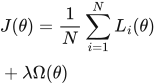
For empirical risk with an optional regularizer:
 LaTeX:
J(\theta)=\frac1N\sum_{i=1}^{N}L_i(\theta)+\lambda\Omega(\theta)The loss value indicates the current objective. Its gradient indicates local sensitivity to parameters. Backpropagation computes this gradient efficiently; the optimizer determines how the parameters are updated from it. A gradient and a loss value cannot be interchanged in the update equation.
Why gradient descent subtracts the gradient
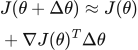
For a small displacement Δθ, first-order Taylor expansion approximates the objective by:
 LaTeX:
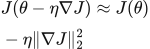
J(\theta+\Delta\theta)\approx J(\theta)+\nabla J(\theta)^T\Delta\thetaChoose Δθ = −η∇J(θ), with η > 0. Substitution gives:
 LaTeX:
J(\theta-\eta\nabla J)\approx J(\theta)-\eta\|\nabla J\|_2^2The squared norm is nonnegative. Therefore the negative-gradient direction is locally a descent direction when the gradient is nonzero. The approximation explains the sign; it does not guarantee that an arbitrarily large finite step decreases loss.
Local minima, global minima and saddle points
A local minimum has objective value no larger than nearby points. A global minimum is minimal over the whole feasible domain. At a saddle point, the objective increases in some directions and decreases in others. A small gradient alone does not establish a minimum: a stationary point can also be a maximum or saddle.
Neural-network objectives are generally nonconvex. Training can encounter flat regions, ill-conditioned valleys, noisy gradient estimates and poor step sizes. Momentum modifies the update direction using previous steps; adaptive methods rescale parameter-specific updates. These methods improve particular optimization behavior, without guaranteeing the global optimum or best test performance.