Deep Learning · TEE · section
Model answer: regularization and the L1–L2 difference
Regularization and generalization
Question
Question. What is regularization? Compare L1 and L2 regularization, including the objective, gradient effect and influence of regularization strength.
Answer — step by step
Regularization restricts or discourages certain fitted solutions to improve generalization. Weight penalties add a cost for parameter size to the training objective. The optimizer must balance fitting the data against that extra cost.
Objectives used in this course
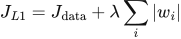 LaTeX:
J_{L1}=J_{\mathrm{data}}+\lambda\sum_i|w_i|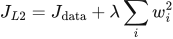 LaTeX:
J_{L2}=J_{\mathrm{data}}+\lambda\sum_iw_i^2Jdata measures prediction error. λ controls the strength of the additional penalty. The sums are over the weights included by the stated question.
| Basis | L1 | L2 |
|---|---|---|
| Quantity penalized | Absolute weight magnitude | Squared weight magnitude |
| Penalty derivative at nonzero w | λ sign(w) | 2λw under the displayed convention |
| Typical effect | Encourages sparse solutions | Smoothly shrinks weight magnitudes |
| Zero weights | Can promote exact zeros with suitable optimization | Usually leaves small nonzero weights |
The total gradient is the data-loss gradient plus the penalty gradient. With w = 2, data gradient 0.3 and λ = 0.1, the displayed L2 penalty adds 2 × 0.1 × 2 = 0.4. The total gradient is 0.7; update using that total.
Increasing λ strengthens the preference for smaller weights. Excessive regularization can prevent learning useful patterns and cause underfitting. L1 is not differentiable at zero, where a subgradient or suitable optimization method is used. If the examination writes λ/2 before the L2 sum, its penalty gradient becomes λw. Derive the factor from the printed objective.