Deep Learning · TEE · section
Why one by one convolution saves work
CNN architectures and transfer learning
Definition. A 1 × 1 convolution combines the input channels independently at each spatial location. A bottleneck uses fewer output channels before a larger spatial convolution, reducing its parameter and multiplication counts.
Question. Input is 28 × 28 × 192. Compare a direct same-padded 5 × 5 convolution with 32 filters against a 1 × 1 reduction to 16 channels followed by the same 5 × 5 convolution. Count MACs and ignore bias additions.
Given
Both paths produce 28 × 28 × 32. The direct layer receives 192 channels; the bottleneck's spatial layer receives 16 channels. Stride is 1 and padding preserves spatial size.
To find
Direct MACs, total two-stage bottleneck MACs and percentage saved.
Formula — which one and why
Each output scalar uses one product per input-channel kernel entry. Multiply that cost by the number of output positions and channels. The two bottleneck layers require separate counts, which are added.
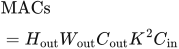 LaTeX:
\mathrm{MACs}=H_{\mathrm{out}}W_{\mathrm{out}}C_{\mathrm{out}}K^2C_{\mathrm{in}}One MAC counts one multiply–accumulate pair. A convention counting multiplication and addition separately gives approximately twice as many FLOPs.
Solution — step by step
Step 1: direct layer. Each output uses 5 × 5 × 192 = 4,800 products. There are 28 × 28 × 32 = 25,088 outputs.
 LaTeX:
\mathrm{MACs}_{\mathrm{direct}}=25088(4800)=120422400Step 2: 1 × 1 reduction. There are 16 receiving filters, each spanning all 192 original channels.
 LaTeX:
\mathrm{MACs}_{1\times1}=28(28)(16)(192)=2408448Step 3: reduced-depth spatial layer. Its 32 filters now span 16 channels.
 LaTeX:
\mathrm{MACs}_{5\times5}=28(28)(32)(25)(16)=10035200Step 4: add the two bottleneck costs.
 LaTeX:
\mathrm{MACs}_{\mathrm{bottleneck}}=2408448+10035200=12443648Step 5: calculate the saving.
 LaTeX:
\mathrm{saving}=120422400-12443648=107978752 LaTeX:
\mathrm{saving\ percentage}=100\frac{107978752}{120422400}\approx89.666667\%Final answer: direct = 120,422,400 MACs; bottleneck = 12,443,648 MACs, saving about 89.67%. Spatial size is unchanged; the saving comes from reducing the channels entering the expensive 5 × 5 layer. If the reduction width is not supplied, use a symbol for it and label any numerical choice as an assumption.
A second bottleneck with different dimensions
Question. An 8 × 8 × 16 input must produce 8 channels using a same-padded 3 × 3 convolution. Compare direct computation with a 1 × 1 reduction to 4 channels followed by the 3 × 3 layer. Count MACs and ignore bias additions.
Given
Spatial output = 8 × 8; original channels = 16; final filters = 8; bottleneck channels = 4; stride = 1.
To find
Direct MACs, bottleneck MACs and saving.
Formula — which one and why
Use the same MAC formula above once for the direct path and once for each bottleneck stage. Every branch must include all of its layers.
Solution — step by step
Step 1: direct spatial convolution.
 LaTeX:
8(8)(8)(3)(3)(16)=73728Step 2: 1 × 1 reduction.
 LaTeX:
8(8)(4)(1)(1)(16)=4096Step 3: reduced-depth 3 × 3 convolution.
 LaTeX:
8(8)(8)(3)(3)(4)=18432Step 4: add the stages and subtract from the direct cost.
 LaTeX:
4096+18432=22528 LaTeX:
73728-22528=51200Final answer: direct = 73,728 MACs; bottleneck = 22,528 MACs; saving = 51,200 MACs, about 69.44%. Both paths produce 8 × 8 × 8, but they are different learned transformations and need not produce identical feature values.