Deep Learning · TEE · section
Vanishing and exploding gradients
Recurrent neural networks
Definition. Vanishing and exploding gradients describe the attenuation or amplification of backward derivatives through repeated Jacobian products. In recurrent networks, these products extend across time and affect long-range credit assignment.
Explanation and working
In BPTT, the gradient repeatedly multiplies recurrent weights and activation derivatives. Products of many small factors can approach zero; early information then receives very little learning signal. Large repeated factors can make the gradient explode. These are about training signals, not an instruction that every hidden-state value must become zero or infinity.
Numerical intuition: 0.5¹⁰ = 0.0009765625, whereas 2¹⁰ = 1,024. Sigmoid's derivative is at most 0.25 and becomes even smaller in saturation. Tanh also saturates for large magnitude inputs.
Useful remedies include LSTM or GRU gates and cell paths, suitable initialization and learning rate, and gradient clipping for explosion. Clipping does not by itself solve vanishing gradients. LSTM makes long-range learning easier; it does not guarantee perfect unlimited memory.
Why the effect grows with sequence length
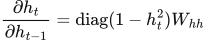
For a vanilla tanh RNN, each hidden-state transition contributes a Jacobian. The derivative through several transitions contains a product of these Jacobians:
 LaTeX:
\frac{\partial h_t}{\partial h_{t-1}}=\operatorname{diag}(1-h_t^2)W_{hh}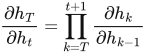 LaTeX:
\frac{\partial h_T}{\partial h_t}=\prod_{k=T}^{t+1}\frac{\partial h_k}{\partial h_{k-1}}The product is ordered from the latest transition toward the earliest. Small activation derivatives and recurrent transformations can attenuate the signal; repeated amplification can make it grow. A one-dimensional product illustrates the issue, but a vector RNN depends on the full matrix products, not one weight alone.
Gradient norm clipping: a complete numerical
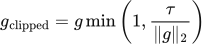
Norm clipping rescales an oversized gradient while retaining its direction. It limits the update size caused by an exploding gradient.
 LaTeX:
g_{\mathrm{clipped}}=g\min\left(1,\frac{\tau}{\lVert g\rVert_2}\right)If g is the zero vector, leave it unchanged. The threshold τ is positive. This is global norm clipping for the vector being considered; elementwise clipping is a different operation.
Question. A gradient is g = [6, 8]ᵀ. Clip its Euclidean norm to at most τ = 5, then update w = [1, 1]ᵀ with learning rate η = 0.1.
Given
Gradient g = [6,8]ᵀ; norm threshold τ = 5.
Old weights w = [1,1]ᵀ; η = 0.1.
To find
Find the clipped gradient and updated weights.
Formula — which one and why
Gradient norm clipping. If the vector norm exceeds the allowed threshold, multiply every component by the same scale. This changes magnitude while preserving direction.
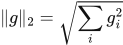
g = gradient vector; τ (tau) = maximum norm; ||g||₂ = square root of the sum of squared components; η = learning rate.
 LaTeX:
\lVert g\rVert_2=\sqrt{\sum_i g_i^2}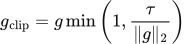 LaTeX:
g_{\mathrm{clip}}=g\min\left(1,\frac\tau{\lVert g\rVert_2}\right) LaTeX:
w_{\mathrm{new}}=w-\eta g_{\mathrm{clip}}Yaad rakhne ka cue: Bada gradient? Sab components ko ek hi factor se chhota karo.
Solution — step by step
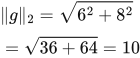
Step 1: calculate the original norm.
 LaTeX:
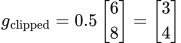
\lVert g\rVert_2=\sqrt{6^2+8^2}=\sqrt{36+64}=10Step 2: find the scale. Since 10 > 5, scale the vector by 5/10 = 0.5.
 LaTeX:
g_{\mathrm{clipped}}=0.5\begin{bmatrix}6\\8\end{bmatrix}=\begin{bmatrix}3\\4\end{bmatrix}Step 3: verify the clipped norm.
 LaTeX:
\sqrt{3^2+4^2}=\sqrt{9+16}=5Step 4: update each parameter with the clipped gradient.
 LaTeX:
w_{1,\mathrm{new}}=1-0.1(3)=0.7 LaTeX:
w_{2,\mathrm{new}}=1-0.1(4)=0.6Final answer: clipped gradient [3, 4]ᵀ and new weights [0.7, 0.6]ᵀ. Clipping does not increase a vanishing gradient and does not replace the need for an appropriate recurrent architecture.
Gradient norm clipping: [3, 4]
Question. Clip gradient g = [3, 4] to maximum L2 norm 10. Use global norm clipping.
Given
g = [3, 4]; threshold τ = 10.
To find
The norm, scaling factor and clipped gradient.
Formula — which one and why
Global norm clipping scales the entire list by one common factor only if its norm exceeds the threshold.
τ is the maximum permitted norm, not a per-entry bound.
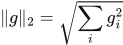 LaTeX:
\|g\|_2=\sqrt{\sum_i g_i^2} LaTeX:
g_{\mathrm{clip}}=g\min(1,\tau/\|g\|_2)Yaad rakhne ka cue: Norm bada ho tab sab entries ko same ratio se chhota karo.
Solution — step by step
Step 1: calculate the squared norm.
 LaTeX:
3^2+4^2=25Step 2: take the square root.
 LaTeX:
\|g\|_2=\sqrt{25}=5Step 3: choose the shared scale.
 LaTeX:
c=\min(1,10/5)=1Step 4: scale every entry.
 LaTeX:
g_1^{\mathrm{clip}}=3(1)=3 LaTeX:
g_2^{\mathrm{clip}}=4(1)=4Final answer: Clipped gradient = [3, 4].
Gradient norm clipping: [0, 12]
Question. Clip gradient g = [0, 12] to maximum L2 norm 3. Use global norm clipping.
Given
g = [0, 12]; threshold τ = 3.
To find
The norm, scaling factor and clipped gradient.
Formula — which one and why
Global norm clipping scales the entire list by one common factor only if its norm exceeds the threshold.
τ is the maximum permitted norm, not a per-entry bound.
LaTeX: \|g\|_2=\sqrt{\sum_i g_i^2}LaTeX: g_{\mathrm{clip}}=g\min(1,\tau/\|g\|_2)Yaad rakhne ka cue: Norm bada ho tab sab entries ko same ratio se chhota karo.
Solution — step by step
Step 1: calculate the squared norm.
 LaTeX:
0^2+12^2=144Step 2: take the square root.
 LaTeX:
\|g\|_2=\sqrt{144}=12Step 3: choose the shared scale.
 LaTeX:
c=\min(1,3/12)=0.25Step 4: scale every entry.
 LaTeX:
g_1^{\mathrm{clip}}=0(0.25)=0 LaTeX:
g_2^{\mathrm{clip}}=12(0.25)=3Final answer: Clipped gradient = [0.0, 3.0].