Disaster Management · M2 · mocks
M2 mock A · theory and diagrams
M2 practice papers
Confirmed 2 + 2 + any two of 3, 3, 3 = 10 marks
Pattern: Q1(a) and Q1(b) are compulsory. Attempt any two of Q2, Q3 and Q4. Printed marks = 13; attempted marks = 10. These are newly written practice questions. Answers are directly below each question.
Q1(a). Differentiate between hazard and disaster using a flood example. [2 practice marks]
Answer
A hazard has the potential to cause harm, whereas a disaster is the serious disruption produced when that hazard affects exposed and vulnerable people or assets. A river rising is a flood hazard; widespread inundation that disrupts homes, hospitals and livelihoods is a flood disaster.
Q1(b). Distinguish NDMA from NDRF. [2 practice marks]
Answer
NDMA is the apex disaster management authority that lays down policies, plans and guidelines and coordinates their implementation. NDRF is a specialised response force that carries out operations such as search and rescue. NDMA’s role is strategic and coordinating; NDRF’s role is primarily operational.
Q2. Explain three ethical duties during disaster response. [3 practice marks]
Answer
- Humanitarian assistance. Protect life and provide essentials according to need. For example, distribute safe drinking water to communities whose supply has failed.
- Information and participation. Give accurate, accessible updates and involve affected people. Explain shelter locations in local languages and listen to residents about missing people.
- Responsible evacuation. Use safe routes, transport and accessible shelters; explain the danger and preserve dignity. Any compulsory evacuation must follow lawful authority and necessity.
Q3. Explain P waves, S waves and surface waves with a labelled sketch. [3 practice marks]
Answer
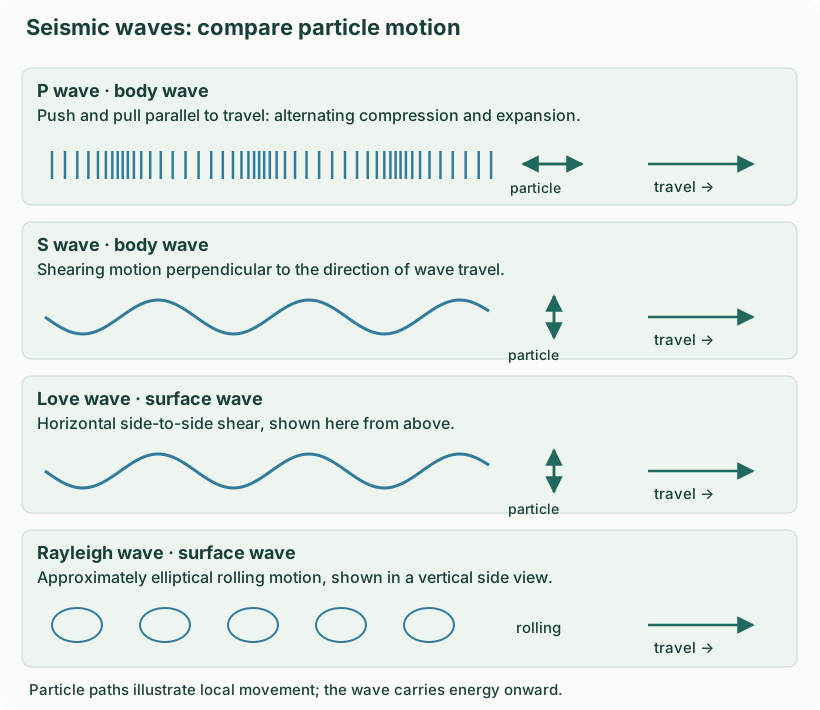
- P waves. Compressional body waves; particle motion is parallel to propagation and they travel through solids and fluids.
- S waves. Shear body waves; particle motion is transverse and they do not pass through fluids as shear waves.
- Surface waves. Travel along the surface; Love waves involve horizontal shear and Rayleigh waves involve rolling motion. They can produce damaging shaking.
Q4. Explain three measures for reducing urban flood risk. [3 practice marks]
Answer
- Maintain the catchment and natural storage. Protect wetlands and floodplains and restore suitable vegetation. These measures slow runoff and store part of the floodwater, although they cannot eliminate extreme floods.
- Manage channels and drainage. Remove blockages and maintain bridges, culverts and drains. Engineering surveys should guide selective desilting; indiscriminate excavation can damage banks and ecosystems.
- Use storage and coordinated reservoir operation. Detention basins and reservoirs can hold water and release it more slowly. Forecasts, operating rules and downstream warnings are essential because storage and outlet capacity are finite.