Disaster Management · TEE · papers
Q5A · Describe in detail six stages of Disaster Management citing relevant examples.
2022-12-01 · Semester V/VII final
Actual older TEE paper · 100 marks · Q1 compulsory; any four of Q2–Q7
Q5A. Describe in detail six stages of Disaster Management citing relevant examples. [10 marks]
Answer
Definition. Disaster management is the organised process of preventing or reducing risk, preparing for emergencies, responding to impacts and supporting recovery.
| Stage | Meaning | One clear example |
|---|---|---|
| Prevention | Avoid a risk where possible. | Keep a new school out of an active floodway. |
| Mitigation | Reduce the severity of losses. | Strengthen an existing school against shaking. |
| Preparedness | Build readiness to act. | Prepare evacuation routes and conduct drills. |
| Response | Take urgent life-saving action. | Rescue trapped people and provide emergency shelter. |
| Recovery | Restore services and livelihoods. | Restore water, power and access to education. |
| Rehabilitation / reconstruction | Restore functioning and rebuild damaged systems more safely. | Rebuild homes to appropriate safety standards. |
Why some diagrams show four stages
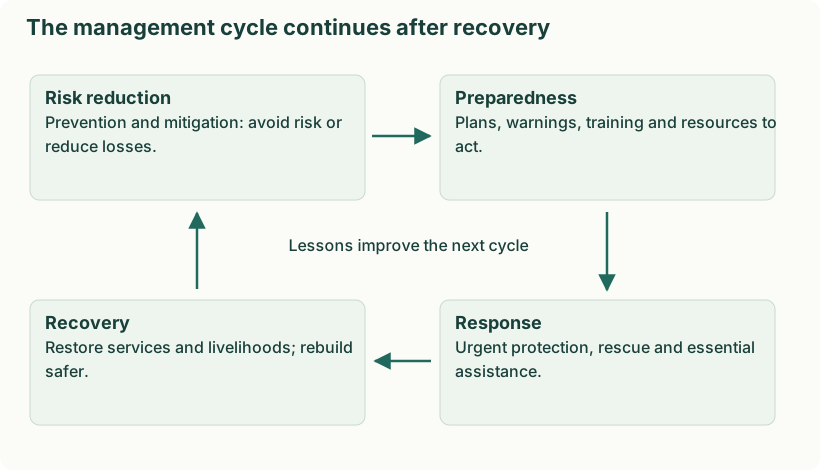
The four-stage cycle uses mitigation → preparedness → response → recovery. Prevention is treated with risk reduction; rehabilitation and reconstruction are included in recovery. The six-stage version separates them for explanation. These activities overlap; response can begin before impact, for example by evacuating after a cyclone warning.
Build Back Better
Recovery should reduce future risk. Rebuilding the same weak house in the same floodway may restore yesterday’s vulnerability. Safer siting, stronger design, accessible services and restored livelihoods improve resilience.