Disaster Management · TEE · papers
Q5A · Describe in detail application of Modes of Early Warning System in Disaster Managemen…
2023-02-07 · Semester V/VII re-exam
Actual older TEE paper · 100 marks · Q1 compulsory; any four of Q2–Q7
Q5A. Describe in detail application of Modes of Early Warning System in Disaster Management of Earthquakes. [10 marks]
Answer
Definition. An early warning system links risk knowledge, hazard monitoring and forecasting, warning communication, and preparedness so people can act before or during the early stages of dangerous impacts.
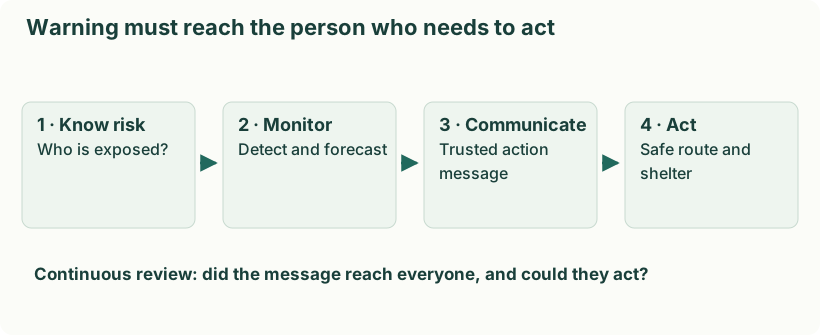
| Component | Question answered | Flood example |
|---|---|---|
| Risk knowledge | Who and what can be harmed? | Map low-lying settlements and people needing assistance. |
| Monitoring and forecasting | What is developing and when might it affect us? | Combine rainfall, river gauges and forecast models. |
| Warning communication | What should people understand and do? | Send an official message naming places, timing and safe actions. |
| Preparedness / response capacity | Can people act on the message? | Open shelters and use rehearsed evacuation arrangements. |
Where monitoring and evaluation fit
Evaluate accuracy, lead time, coverage, comprehension and actual response; improve the system after drills and real events. The lecture groups the first two components under “risk knowledge and monitoring” and lists evaluation as a fourth level. The widely used four-pillar model above separates risk knowledge from forecasting and treats evaluation as continuous. Both descriptions require communication and action.
Definition. Earthquake risk reduction combines safe construction, non-structural safety, preparedness and coordinated response. Precise earthquake prediction is not a dependable safety strategy.
Before shaking
- Get qualified assessment of vulnerable structures; retrofit where needed and enforce safe design.
- Secure shelves, cylinders and heavy objects; keep heavy items low.
- Prepare a family communication plan, emergency kit and accessible evacuation arrangements. Practise Drop, Cover and Hold On.
During shaking
Indoors, Drop, Cover and Hold On: get low, protect your head and neck under sturdy cover where possible, and hold on. Keep away from glass. Do not rush towards stairs or lifts while the building is shaking. Outdoors, move away from buildings and overhead lines if safe. In a vehicle, stop in a safe clear place away from bridges and hazards and remain inside until shaking stops.
After shaking
Expect aftershocks. Leave a damaged building by a safe route when shaking stops; do not use lifts or re-enter until cleared. Avoid damaged utilities and flames near suspected gas leaks. Follow official information. On a threatened coast, strong or long shaking is a reason to follow tsunami evacuation procedures without waiting at the beach.
Agency responsibilities
- Response: rapid assessment, search and rescue, emergency care, firefighting, accessible shelter, communication and restoration of critical services.
- Recovery: inspect and repair lifelines, restore housing and livelihoods, support mental health, and document damage.
- Mitigation: revise unsafe siting and strengthen critical buildings rather than reproduce previous weaknesses.
Cordon-off zones
A cordon is a controlled boundary around a dangerous site. Authorities assess hazards, mark the perimeter, create controlled access points, communicate restrictions and keep responder routes clear. Exclusion zones keep the public away from high danger; restricted zones permit specified authorised tasks; safe assembly areas provide refuge. Distances depend on the incident. Do not treat “gold, silver and bronze” as universal fixed-distance hazard rings: those terms are also used for command levels.