Disaster Management · TEE · papers
Q2A · Discuss in detail Disaster Reporting and Management hierarchy in India.
2023-05-04 · Semester VI final
Actual older TEE paper · 100 marks · Q1 compulsory; any four of Q2–Q7
Q2A. Discuss in detail Disaster Reporting and Management hierarchy in India. [10 marks]
Answer
Definition. Structured incident reporting gives responders a common picture of an emergency. METHANE is a widely used multi-agency reporting mnemonic that appears in the supplied archive’s TEE questions.
| Letter | Information to report |
|---|---|
| M | Major incident: declared or not; do not invent a declaration. |
| E | Exact location: identifiable site and geographic details. |
| T | Type of incident. |
| H | Hazards present or developing. |
| A | Access: safe entry and exit routes, including blockages. |
| N | Number and condition of casualties; label estimates and unknowns. |
| E | Emergency services present and required. |
The acronym is not a chemistry question about methane gas. Send a short verified initial report, distinguish observations from estimates, and update as information changes. Exact procedures follow the relevant response organisation; this mnemonic is included as an archival examination application.
Example report: hypothetical flood incident
Major incident status: awaiting confirmation. Location: east-bank bridge approach, Ward 4. Type: river inundation. Hazards: fast water and damaged power line. Access: west approach closed; north road currently confirmed usable. Casualties: three people reported stranded; injury status unknown. Services: local police on scene; authorised rescue and utility support requested. This is an illustration, not a report of a real event.
Emergency management expert: role by phase
- Assess hazards and vulnerability and translate findings into plans.
- Define responsibilities and coordinate agencies, communities and resources.
- Train personnel, organise safe drills and improve weak procedures.
- During response, support verified information, priorities and resource allocation.
- During recovery, assess needs, restore systems, plan resilient reconstruction and review lessons.
Worked incident report: illustrative details
| Field | Example report |
|---|---|
| M | Major incident declared by the authorised incident commander. |
| E | Example: Riverside School, east gate, mapped grid reference shared with control. |
| T | Flooding with people stranded. |
| H | Fast water, submerged electrical equipment and unstable walls. |
| A | Use the northern approach; southern bridge reported closed. Confirm route status. |
| N | Twenty people reported stranded; injuries not yet confirmed. |
| E | Police and fire teams on scene; request water rescue and medical support. |
Update time-stamped information as it is verified. METHANE is an acronym for structured reporting here, not the chemical methane gas.
Definition. India’s disaster management framework distributes policy, planning and response responsibilities across national, state, district and local levels.
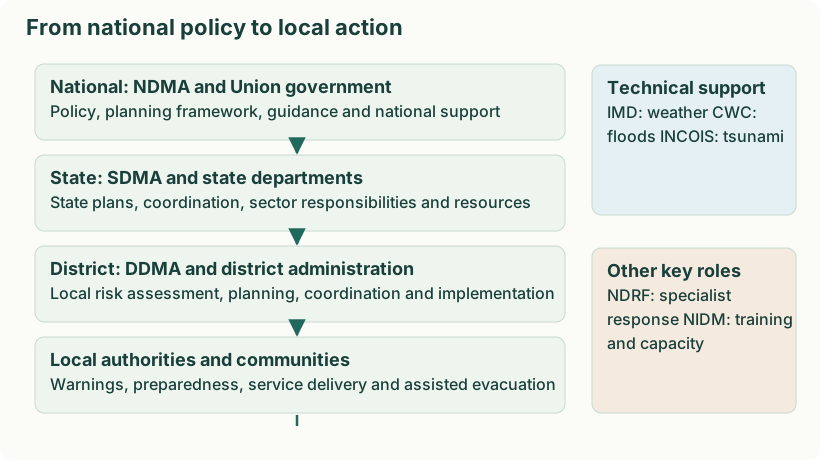
| Body | Full name / leadership | Main role |
|---|---|---|
| NDMA | National Disaster Management Authority; chaired by the Prime Minister | National policy, plans, guidelines and coordination for risk reduction and effective response. |
| SDMA | State Disaster Management Authority; chaired by the Chief Minister | State policy, plans and coordination adapted to the state’s risks. |
| DDMA | District Disaster Management Authority; headed by the District Magistrate / Collector / Deputy Commissioner | District planning, coordination, preparedness and local implementation; elected local representative has a co-chairing role under the Act. |
| NDRF | National Disaster Response Force | Specialist response including search, rescue and disaster operations. |
| NIDM | National Institute of Disaster Management | Training, capacity building, research and documentation. |
| Local authorities | Municipalities, panchayats and local services | Maintain local services, implement safety measures and assist warnings, evacuation and relief. |
An authority frames policy and coordinates. A force provides operational response. An institute develops skills and knowledge. They are not interchangeable. State and local services also respond; it is incorrect to suggest that only NDRF does rescue.