Disaster Management · TEE · papers
Q1D · Discuss in detail the three causes resulting in earthquakes with neat sketches.
2023-07-05 · Semester VI re-exam
Actual older TEE paper · 100 marks · Q1 compulsory; any four of Q2–Q7
Q1D. Discuss in detail the three causes resulting in earthquakes with neat sketches. [5 marks]
Answer
Definition. An earthquake is ground shaking caused by a sudden release of stored energy in the Earth. Most destructive earthquakes result from sudden slip on a fault, sending out seismic waves.
Build the idea one step at a time
- The outer rigid Earth is divided into tectonic plates. Their slow relative movement loads rocks with stress.
- A fault is a fracture or zone of fractures along which rock blocks can move. Friction can temporarily lock the blocks.
- The rocks deform and store elastic energy. When stress exceeds the resistance to slip, the fault moves suddenly. This is the elastic-rebound explanation.
- Energy travels outward as seismic waves. These cause shaking at the surface. The waves carry the released energy; they are not the original tectonic cause.
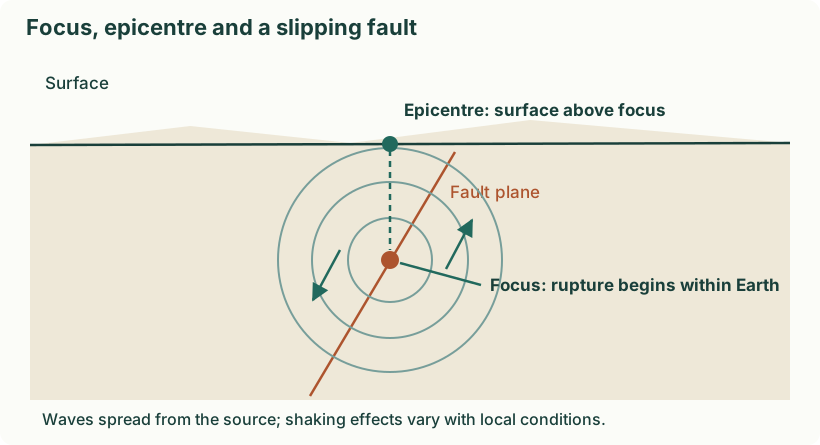
Diagram: Focus, epicentre and a slipping fault. Labels: Focus, epicentre and a slipping fault | Focus, epicentre and a slipping fault | Fault plane | Epicentre: surface above focus | Focus: rupture begins within Earth | Surface | Waves spread from the source; shaking effects vary with local conditions.
| Word | Meaning |
|---|---|
| Focus / hypocentre | The point inside the Earth where rupture begins. |
| Epicentre | The point on the surface vertically above the focus. |
| Focal depth | Vertical distance from the surface to the focus. |
| Foreshock / mainshock / aftershock | Smaller preceding event, largest event in a sequence, and subsequent events; “foreshock” is usually identified retrospectively. |
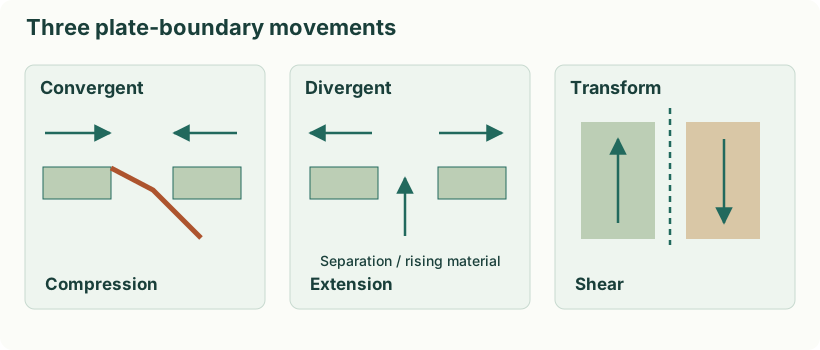
Diagram: Three plate-boundary movements. Labels: Three plate-boundary movements | Three plate-boundary movements | Convergent | Divergent | Transform | Separation / rising material | Compression | Extension | Shear
Most earthquakes result from sudden fault slip releasing stored strain. Volcanic processes, collapse and certain human activities can also generate earthquakes; seismic waves are the released energy travelling outward, not the underlying tectonic cause.
Three plate movements that build stress
- Convergence. Plates move together, causing compression, subduction or collision. Locked faults can release stored energy suddenly.
- Divergence. Plates separate and the crust extends. Faulting associated with extension can generate earthquakes.
- Transform motion. Plates slide past one another. Friction can lock parts of a fault until stress overcomes resistance and slip occurs.