Disaster Management · TEE · papers
Q4A · Discuss in detail any five ways adopted for Risk Reduction.
2023-07-05 · Semester VI re-exam
Actual older TEE paper · 100 marks · Q1 compulsory; any four of Q2–Q7
Q4A. Discuss in detail any five ways adopted for Risk Reduction. [10 marks]
Answer
- Reduce exposure. Avoid siting new homes or hospitals in mapped floodways or unstable slopes.
- Reduce vulnerability. Strengthen buildings, improve drainage and make warnings and transport accessible.
- Strengthen capacity. Train responders, prepare shelters and rehearse coordinated action.
- Reduce suitable hazards at source. Maintain industrial equipment, stabilise slopes where feasible and manage combustible material appropriately.
- Manage remaining consequences. Prepare continuity, recovery and financial/social protection arrangements because residual risk remains.
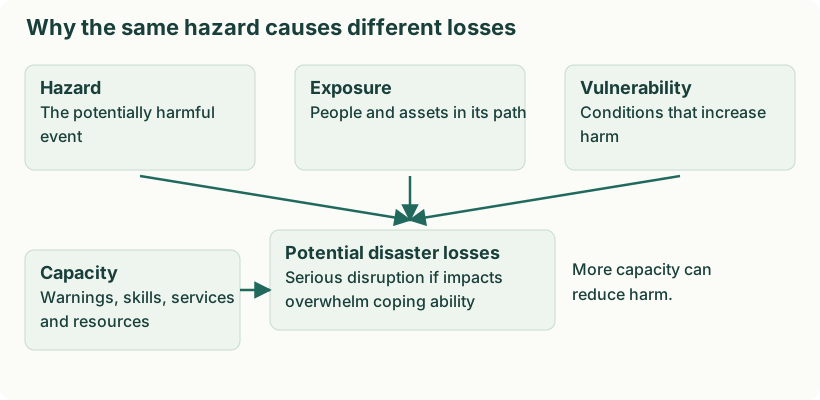
Apply these measures together. In a flood-prone town, preventing new settlement in the floodway reduces exposure. Raising or protecting critical equipment reduces vulnerability. Accessible warning messages, shelters and assisted transport increase capacity. Removing drainage blockages can reduce local flooding, although it cannot remove every extreme rainfall hazard. Backup water supplies and a recovery plan manage the risk that remains. Maintenance and community participation are essential: a blocked drain or inaccessible shelter may exist on paper without providing protection. Risk reduction therefore continues before, during and after an event and should be part of routine development decisions.