Disaster Management · TEE · papers
Q1A · Discuss in detail the difference between Risk and Hazard citing relevant examples.
2023-12-04 · Semester V final
Actual older TEE paper · 100 marks · Q1 compulsory; any four of Q2–Q7
Q1A. Discuss in detail the difference between Risk and Hazard citing relevant examples. [5 marks]
Answer
| Term | Meaning | Example |
|---|---|---|
| Risk | Potential loss arising from hazardous events interacting with exposed and vulnerable people/assets. | Possible damage to homes in a floodplain. |
| Vulnerability | Conditions that make people or assets susceptible to harm. | Weak housing or lack of accessible evacuation transport. |
| Hazard | A process or event with the potential to cause harm. | A cyclone or toxic gas release. |
| Preparedness | Knowledge, plans and resources enabling effective action. | A rehearsed evacuation plan and ready shelters. |
| Mitigation | Measures that lessen likely harm. | Retrofitting a vulnerable building. |
Definition. A hazard is a potentially harmful process, phenomenon or human activity. A disaster is a serious disruption of a community caused when hazardous events interact with exposure, vulnerability and limited capacity.
One example, from cause to consequence
Heavy rain is a hazard. People living beside an overflowing drain are exposed. Weak houses and blocked drainage increase vulnerability. Rescue boats, warnings and safe shelters increase capacity. If flooding seriously disrupts lives, services and livelihoods, the event becomes a disaster.
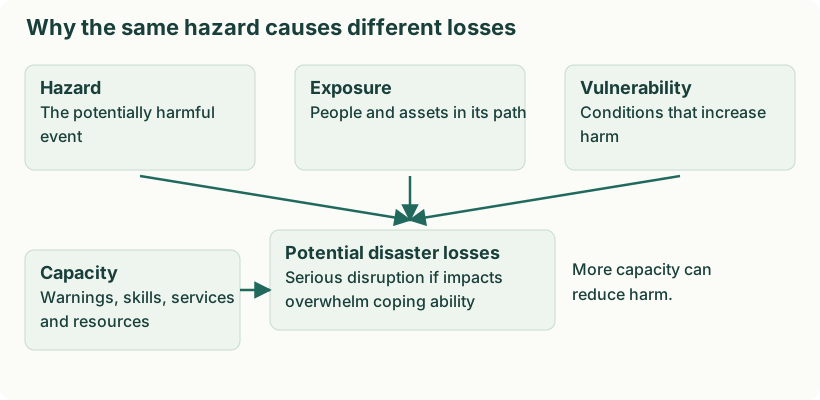
Diagram: Why the same hazard causes different losses. Labels: Why the same hazard causes different losses | Why the same hazard causes different losses | Hazard | The potentially harmful | event | Exposure | People and assets in its path | Vulnerability | Conditions that increase | harm | Potential disaster losses | Serious disruption if impacts | overwhelm coping ability | Capacity | Warnings, skills, services | and resources | More capacity can | reduce harm.
| Term | Meaning | Flood example |
|---|---|---|
| Hazard | What can cause harm? | Heavy rainfall / high river flow |
| Exposure | Who or what is in the affected place? | Homes beside the river |
| Vulnerability | Why can those exposed suffer damage? | Weak houses; limited mobility; poor drainage |
| Capacity | What strengths help manage the threat? | Warnings, shelters, trained rescue teams |
| Disaster risk | Potential losses before the event occurs | Possible deaths, damage and disruption |
| Disaster | Serious disruption when the event occurs | Homes inundated and essential services overwhelmed |