Disaster Management · TEE · papers
Q3A · Discuss in detail with neat sketch formation of Cyclone and elaborate in detail each …
2023-12-04 · Semester V final
Actual older TEE paper · 100 marks · Q1 compulsory; any four of Q2–Q7
Q3A. Discuss in detail with neat sketch formation of Cyclone and elaborate in detail each component of Cyclone. [10 marks]
Answer
Definition. A cyclone is an atmospheric circulation around a low-pressure centre. A tropical cyclone is an organised rotating storm over warm tropical or subtropical waters, with strong winds, rain and potentially storm surge.
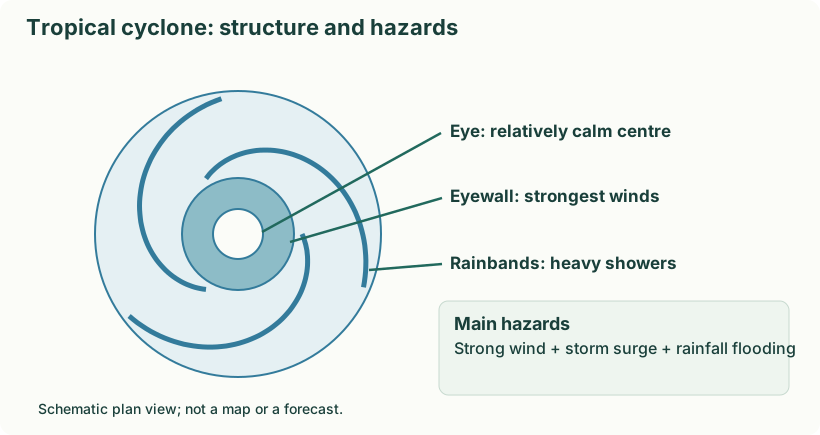
- Warm ocean water supplies moisture and energy by evaporation. Typical favourable sea-surface temperatures are around 26–27°C or higher over adequate depth.
- Warm moist air rises; condensation releases latent heat, supporting further rising motion.
- Air flows towards the low-pressure centre. Earth’s rotation helps organise the circulation; systems do not usually form right at the equator.
- With favourable conditions such as sufficient moisture and limited disruptive vertical wind shear, the system organises and intensifies.
- A mature system may develop an eye surrounded by an eyewall. It weakens when it loses favourable ocean energy or encounters hostile atmospheric conditions.
| Part | Meaning |
|---|---|
| Eye | Relatively calm central region with descending air in a well-developed cyclone. |
| Eyewall | Ring of intense convection; strongest winds and heavy rainfall are commonly found here. |
| Rainbands | Spiral bands of clouds and rain around the centre. |
| Track | The path followed by the storm; forecasts have uncertainty. |
Definition. The principal tropical-cyclone hazards are strong winds, heavy rainfall and storm surge. Their combined effects can create cascading damage.
| Hazard | Mechanism | Damage |
|---|---|---|
| Wind | Strong pressure gradients drive fast winds. | Roof damage, flying debris, fallen trees and power lines. |
| Rain | Intense rainfall produces runoff. | River/urban flooding and landslides. |
| Storm surge | Wind pushes sea water towards shore; low pressure adds a smaller contribution. | Coastal inundation, saltwater intrusion and erosion. |
Storm tide combines astronomical tide and storm surge; waves and river flooding can compound impacts further. A tsunami is a different process, usually generated by sudden displacement of the water column.
Names and classifications without mixing systems
Hurricane is the regional name used in the Atlantic and northeast Pacific; typhoon in the northwest Pacific; tropical cyclone or cyclonic storm is used in the Indian Ocean context. A tornado is a small-scale rotating column connected to a thunderstorm and is not a South American synonym for tropical cyclone. A mesocyclone is a rotating thunderstorm updraft. Polar and extratropical cyclones occur in different environments and should not be described as identical warm-ocean systems.
In the Northern Hemisphere, cyclonic circulation is anticlockwise; in the Southern Hemisphere, clockwise. India’s Bay of Bengal and Arabian Sea coasts both face serious cyclone risk. Not every Indian cyclone is moderate.
Wind categories need their own units and definitions
The PPT shows both a Saffir–Simpson hurricane image and a gust-based five-category table. They are not interchangeable with IMD’s North Indian Ocean classification. Use the named system supplied in a question; do not mix gust speed with sustained wind speed. The key M2 concepts are formation, hazards, warnings and mitigation.