Disaster Management · TEE · papers
Q1B · With neat labelled sketch elaborate in detail the phases of Disaster Cycle considerin…
2024-12-10 · Semester V final
Actual older TEE paper · 100 marks · Q1 compulsory; any four of Q2–Q7
Q1B. With neat labelled sketch elaborate in detail the phases of Disaster Cycle considering any one type of disaster. [5 marks]
Answer
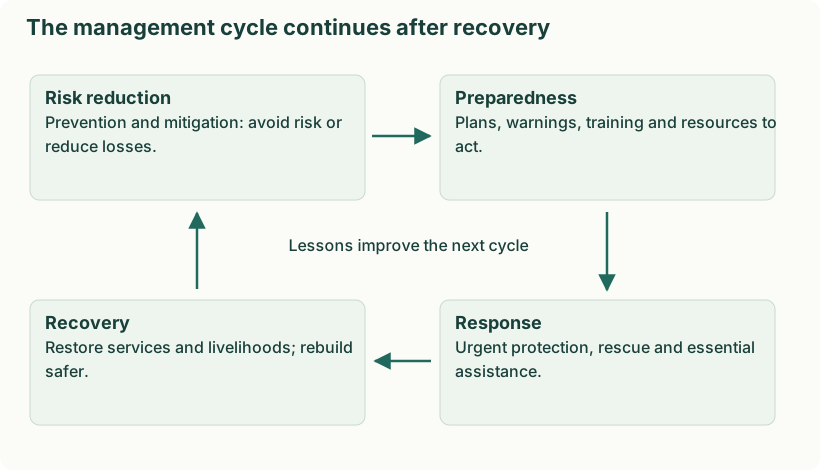
- Prevention and mitigation. Reduce avoidable vulnerability through watershed conservation, suitable cropping, efficient water use and sustainable groundwater management. These do not prevent every rainfall deficit.
- Preparedness. Monitor rainfall, storage and crop stress; plan water priorities, advisories, supply contingencies and livelihood support.
- Response. Provide safe drinking water and urgent livelihood, fodder or health support according to assessed need; manage scarce resources fairly.
- Recovery. Restore productive capacity and livelihoods, repair water systems and improve future planning. Review whether reconstruction and new demand would recreate the same water stress.
How the cycle connects in one village
Before a deficient monsoon, the village improves storage and water-use efficiency: this is mitigation. When monitoring shows a deficit, authorities activate a prepared priority-supply plan: this is preparedness. During severe shortage, safe drinking-water supply and targeted livelihood assistance are response. After conditions improve, repairing sources and restoring livelihoods are recovery. Reviewing which households were excluded should change the next plan. Thus recovery feeds into better mitigation and preparedness rather than simply restoring the earlier vulnerability.
In the six-stage lecture diagram, prevention and mitigation are shown separately, and rehabilitation/reconstruction are distinguished within recovery. The stages can overlap; an activity is classified by its purpose, not just its calendar date.