Disaster Management · TEE · papers
Q3A · Illustrate with neat sketch any 2 types of waves causing earthquake and any 2 types o…
2025-02-25 · Semester V re-exam
Actual older TEE paper · 100 marks · Q1 compulsory; any four of Q2–Q7
Q3A. Illustrate with neat sketch any 2 types of waves causing earthquake and any 2 types of earthquakes. Also explain the same in detail. [10 marks]
Answer
Definition. Seismic waves are disturbances carrying earthquake energy. Body waves travel through the Earth; surface waves propagate along its surface.
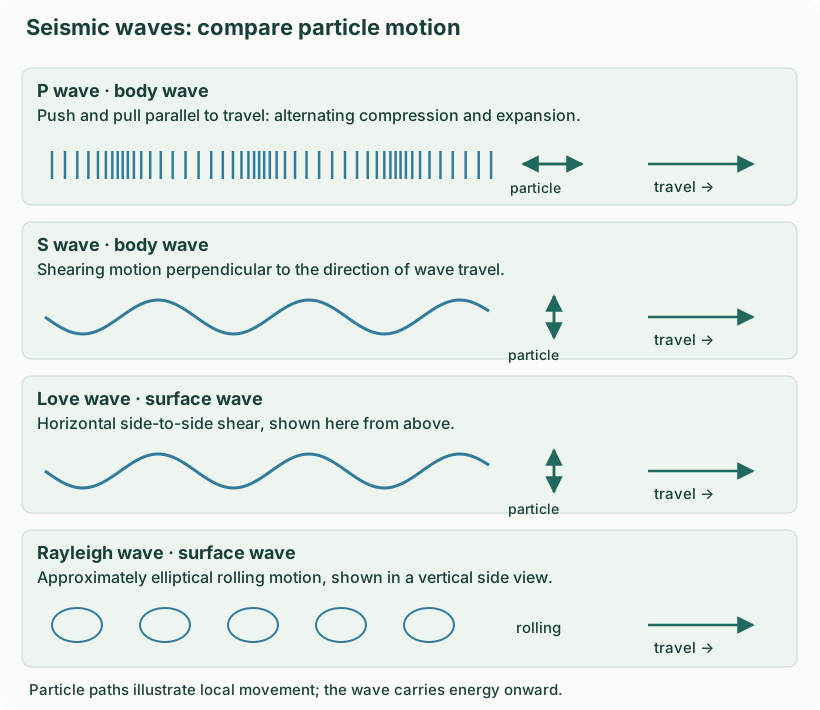
| Wave | Particle movement | Travel / key point |
|---|---|---|
| P: primary | Compression and expansion parallel to travel direction. | Fastest body wave; travels through solids and fluids. |
| S: secondary | Shearing perpendicular to travel direction. | Slower than P; cannot propagate through liquids as shear waves. |
| Love | Horizontal side-to-side surface motion. | Surface wave; produces strong lateral shaking. |
| Rayleigh | Rolling, approximately elliptical motion in a vertical plane. | Surface wave with vertical and horizontal ground movement. |
“Direction of travel” means where wave energy moves. “Particle movement” means how a small part of the ground moves locally. A particle need not travel all the way from the fault to your city. Do not list Love waves as body waves.
How shaking is recorded
A seismometer senses ground movement. A seismograph is the sensing-and-recording system; a seismogram is its record. A classical instrument uses inertia: the supporting ground moves relative to a suspended mass. Modern electronic instruments record a time series. Sensor, recorder and timing reference are the three basic components.
Why P–S arrival separation is useful
P waves arrive first because they travel faster. The P–S time gap generally increases with source distance. Records from several stations constrain earthquake location. One station alone does not uniquely locate an epicentre; real location calculations use travel-time models.
Definition. Earthquakes can be classified by their cause, position relative to plates and focal depth. These are different classification bases, so one event can belong to several categories at once.
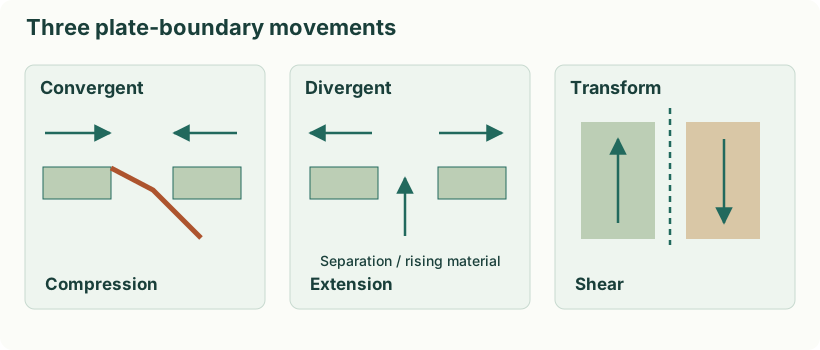
| Boundary | Movement | Typical process |
|---|---|---|
| Convergent | Plates move towards one another. | Subduction or continental collision builds compressive stress. |
| Divergent | Plates move apart. | Extension and faulting occur as new crust forms at spreading boundaries. |
| Transform | Plates slide horizontally past one another. | Shear stress is released along strike-slip faults. |
| Classification | Types and meaning |
|---|---|
| By plate position | Interplate: at a plate boundary. Intraplate: within a plate away from its boundary; old faults can reactivate. |
| By cause | Tectonic movement; volcanic activity; collapse in cavities; induced events associated with activities such as mining or reservoir loading. |
| By focal depth | Common seismological grouping: shallow 0–70 km, intermediate 70–300 km, deep 300–700 km. Boundary conventions may be inclusive on either side. |
A shallow event can produce severe local shaking because its source is close to the surface, but depth alone does not determine damage. Magnitude, distance, soil, construction and preparedness also matter. Intraplate does not mean harmless: Kutch and the peninsular region have experienced damaging earthquakes.