Disaster Management · TEE · papers
Q5B · Discuss in detail with neat sketch Disaster Cycle and explain progression of scale co…
2025-05-12 · Semester VI final
Actual older TEE paper · 100 marks · Q1 compulsory; any four of Q2–Q7
Q5B. Discuss in detail with neat sketch Disaster Cycle and explain progression of scale considering any one Disaster. [10 marks]
Answer
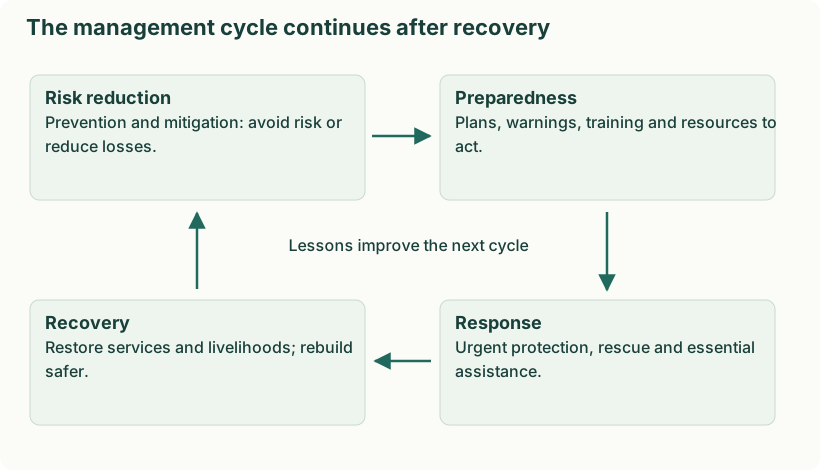
Definition. Disaster management is the organised process of preventing or reducing risk, preparing for emergencies, responding to impacts and supporting recovery.
| Stage | Meaning | One clear example |
|---|---|---|
| Prevention | Avoid a risk where possible. | Keep a new school out of an active floodway. |
| Mitigation | Reduce the severity of losses. | Strengthen an existing school against shaking. |
| Preparedness | Build readiness to act. | Prepare evacuation routes and conduct drills. |
| Response | Take urgent life-saving action. | Rescue trapped people and provide emergency shelter. |
| Recovery | Restore services and livelihoods. | Restore water, power and access to education. |
| Rehabilitation / reconstruction | Restore functioning and rebuild damaged systems more safely. | Rebuild homes to appropriate safety standards. |
Why some diagrams show four stages
The four-stage cycle uses mitigation → preparedness → response → recovery. Prevention is treated with risk reduction; rehabilitation and reconstruction are included in recovery. The six-stage version separates them for explanation. These activities overlap; response can begin before impact, for example by evacuating after a cyclone warning.
Build Back Better
Recovery should reduce future risk. Rebuilding the same weak house in the same floodway may restore yesterday’s vulnerability. Safer siting, stronger design, accessible services and restored livelihoods improve resilience.
Definition. A response level indicates the capacity needed to manage an event. It is different from a physical magnitude or intensity scale.
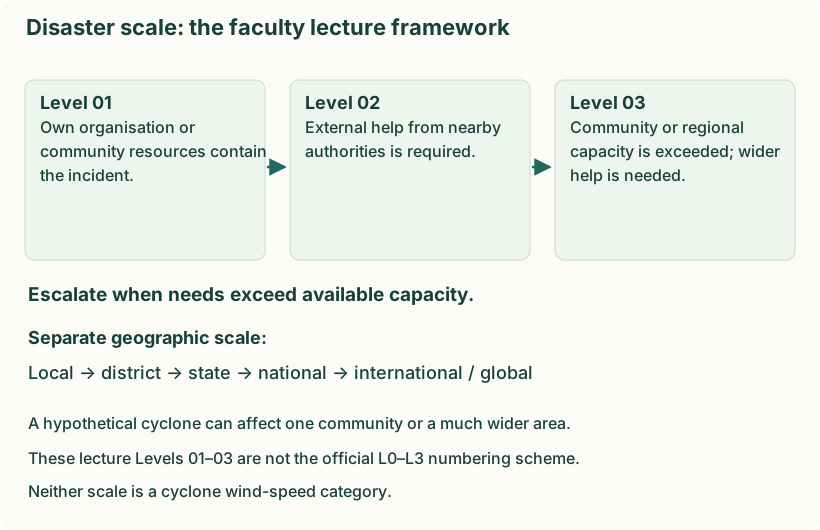
1. Three levels used in the faculty lecture
| Lecture level | Meaning | Cyclone illustration — a hypothetical escalation |
|---|---|---|
| Level 01 | An organisation, institution or community contains the incident using its own resources. | A community shelter deals with limited roof damage and assists its occupants using its trained team and stored supplies. |
| Level 02 | The affected organisation or community needs external help from nearby authorities. | Damage exceeds that team’s resources, so nearby fire, medical and local-authority services provide additional help. |
| Level 03 | The event exceeds the community or regional capacity and requires district / provincial or wider assistance. | Several affected communities need coordinated district/state evacuation, shelter, transport and specialist support. |
2. Geographic / administrative scale
Local → district → state → national → international / global. These describe how widely an event affects people and which territorial levels become involved. For a cyclone, one settlement may be affected locally, several settlements across a district may require district coordination, and several districts or states may require wider support. International assistance is an additional possibility when requested and needed, not an automatic final stage of every disaster.
3. Why numbering conventions must not be mixed
Indian disaster plans also use an L0–L3 planning convention: L0 is normal preparedness; L1 can be handled at district level; L2 requires state assistance; L3 requires national assistance when state and district capacity is exceeded. This is a different definition of the numbers from the lecture’s organisation/community-based Levels 01–03 above. For this course’s “disaster scale” answer, explain the lecture framework first. If a question explicitly gives the official planning convention, use that convention throughout.
4. Significance of the scale
- Recognise unmet needs: compare actual damage and urgent requirements with available people, equipment and supplies.
- Escalate early: request outside help before local services are overwhelmed.
- Assign coordination: identify which agencies must cooperate and who will communicate decisions.
- Allocate resources: send rescue teams, transport, shelters and medical support where the gap is greatest.
- Review as conditions change: a cyclone’s scale can grow or reduce as impacts and capacity change. Wind speed alone does not determine the response level.