Disaster Management · TEE · papers
Q3B · Prepare the checklist for 10 key considerations for Planning of Fire Drill in an Inst…
2025-12-10 · Semester V final
Actual TEE paper · 100 marks · 3 hours · Q1 + any four of Q2–Q7
Q3B. Prepare the checklist for 10 key considerations for Planning of Fire Drill in an Institution Building [10 marks]
Answer
A fire drill is a planned rehearsal of emergency procedures. The checklist should test safe action and reveal practical weaknesses without creating a real hazard.
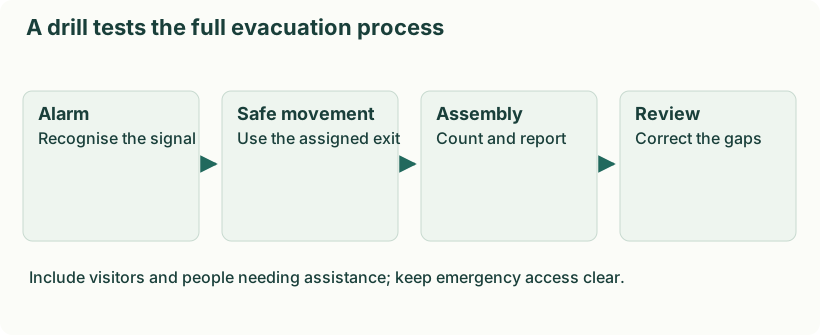
Diagram: A drill tests the full evacuation process. Labels: A drill tests the full evacuation process | A drill tests the full evacuation process | Alarm | Recognise the signal | Safe movement | Use the assigned exit | Assembly | Count and report | Review | Correct the gaps | Include visitors and people needing assistance; keep emergency access clear.
- Assess the building. Identify ignition sources, fuel, occupancy and high-risk rooms; choose a realistic scenario.
- Set objectives. Decide whether the drill tests alarm recognition, evacuation, assisted movement or accountability.
- Inspect exits. Check that exit routes are marked, usable and free of obstructions; do not create unsafe bottlenecks.
- Choose an assembly point. Select a safe, accessible place away from smoke, structures and emergency vehicle access.
- Test communication. Check alarms and public-address systems; prepare a backup and an unambiguous signal for a real emergency.
- Assign responsibilities. Name an incident coordinator, floor wardens, first-aid staff and people responsible for counting occupants.
- Include everyone. Plan assistance for persons with disabilities, visitors and others needing support; brief helpers in advance.
- Coordinate services. Inform relevant building managers and emergency services; keep equipment ready for trained users.
- Observe and account. Record movement and delays, conduct a headcount, report missing people and keep participants from re-entering.
- Debrief and correct. Review observations, assign corrective actions, update the plan and repeat the drill after improvements.