Disaster Management · TEE · papers
Q6B · Elaborate in detail the concept of Cordon-Off Zone. Also Draft a typical Cordon-Off Z…
2025-12-10 · Semester V final
Actual TEE paper · 100 marks · 3 hours · Q1 + any four of Q2–Q7
Q6B. Elaborate in detail the concept of Cordon-Off Zone. Also Draft a typical Cordon-Off Zone to be adopted for the Tsunami Disaster Management [10 marks]
Answer
A cordon is a controlled boundary used to keep people away from danger and organise safe access. Its location depends on the actual hazard, changing conditions, terrain and operations; it is not a fixed-radius circle for every event.
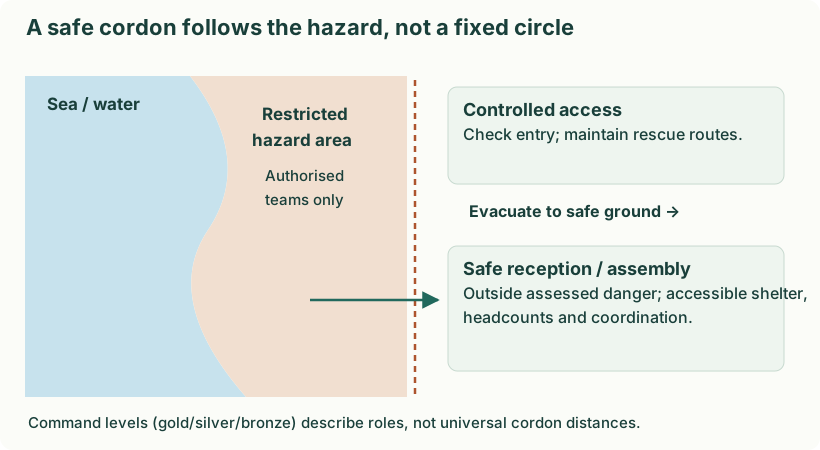
Diagram: A safe cordon follows the hazard, not a fixed circle. Labels: A safe cordon follows the hazard, not a fixed circle | A safe cordon follows the hazard, not a fixed circle | Sea / water | Restricted | hazard area | Authorised | teams only | Controlled access | Check entry; maintain rescue routes. | Safe reception / assembly | Outside assessed danger; accessible shelter, | headcounts and coordination. | Evacuate to safe ground → | Command levels (gold/silver/bronze) describe roles, not universal cordon distances.
- Inner restricted area. The inundated or otherwise dangerous area is restricted to authorised, appropriately equipped teams. Control entry and exit and keep untrained people away from moving water, debris, unstable buildings and electrical hazards.
- Controlled support area. Place access control, team briefing, equipment and appropriate casualty transfer at a safe boundary. Maintain rescue routes and prevent crowds from obstructing operations. Move this area if conditions change.
- Safe outer area. Locate assembly, public information, relief reception and coordination outside the hazard. Keep access available for emergency vehicles and account for evacuees.
- Command and review. Bronze, silver and gold commonly describe operational, tactical and strategic command responsibilities. The lecture illustrates them as zones; they do not define universal physical distances. Review boundaries after updated forecasts, damage reports or an official all-clear.
Tsunami application: close access to beaches and low-lying inundation routes, move people inland/uphill to designated safe areas, permit only controlled rescue access and keep the exclusion in place while further waves remain possible. A tsunami can arrive as several waves; the first is not necessarily the largest.