Disaster Management · TEE · papers
Q2A · Discuss in detail with neat sketch any 3 types of seismic waves. Also explain the con…
2026-02-12 · Semester V re-exam
Actual TEE paper · 100 marks · 3 hours · Q1 + any four of Q2–Q7
Q2A. Discuss in detail with neat sketch any 3 types of seismic waves. Also explain the concept of cordon-off zone and draft typical cordon-off zone for each type of seismic waves. [10 marks]
Answer
Definition. Seismic waves are disturbances carrying earthquake energy. Body waves travel through the Earth; surface waves propagate along its surface.
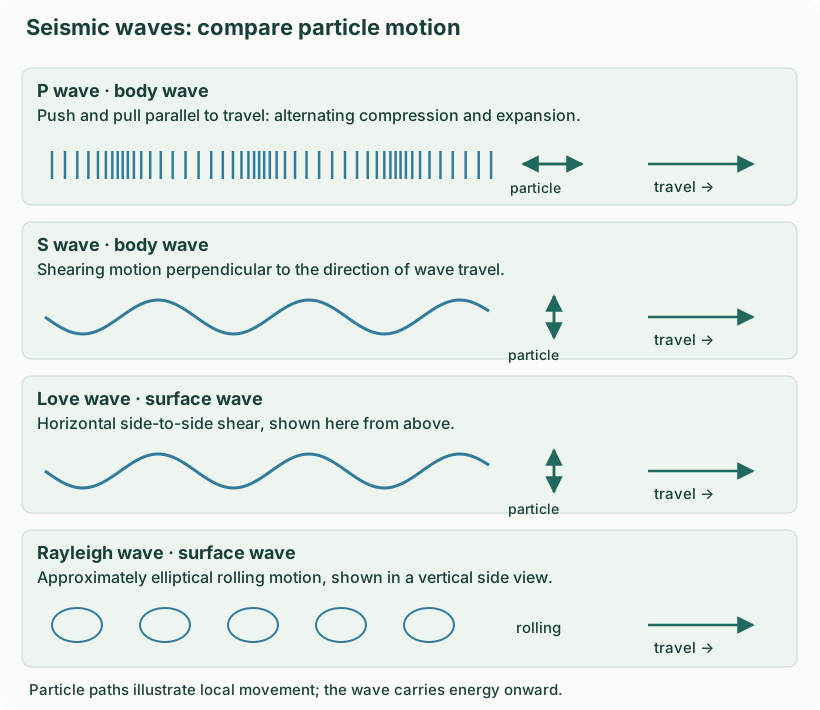
| Wave | Particle movement | Travel / key point |
|---|---|---|
| P: primary | Compression and expansion parallel to travel direction. | Fastest body wave; travels through solids and fluids. |
| S: secondary | Shearing perpendicular to travel direction. | Slower than P; cannot propagate through liquids as shear waves. |
| Love | Horizontal side-to-side surface motion. | Surface wave; produces strong lateral shaking. |
| Rayleigh | Rolling, approximately elliptical motion in a vertical plane. | Surface wave with vertical and horizontal ground movement. |
“Direction of travel” means where wave energy moves. “Particle movement” means how a small part of the ground moves locally. A particle need not travel all the way from the fault to your city. Do not list Love waves as body waves.
How shaking is recorded
A seismometer senses ground movement. A seismograph is the sensing-and-recording system; a seismogram is its record. A classical instrument uses inertia: the supporting ground moves relative to a suspended mass. Modern electronic instruments record a time series. Sensor, recorder and timing reference are the three basic components.
Why P–S arrival separation is useful
P waves arrive first because they travel faster. The P–S time gap generally increases with source distance. Records from several stations constrain earthquake location. One station alone does not uniquely locate an epicentre; real location calculations use travel-time models.
A cordon is a controlled boundary separating an assessed danger area from safe public access. After an earthquake it follows damage and secondary hazards, not the distance travelled by a particular wave.
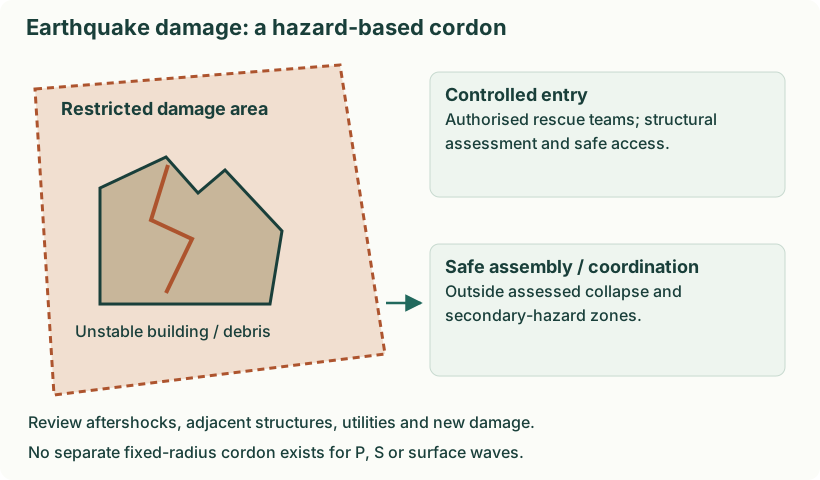
- Restrict the dangerous area. Keep the public away from unstable buildings, falling debris, damaged utilities and possible collapse zones. Specialist assessment guides the boundary.
- Control rescue access. Authorised and properly equipped teams enter through managed access points. Maintain a clear route for rescue vehicles and casualty transfer.
- Provide safe outer coordination. Place assembly, information, medical support and command outside the assessed danger. Account for evacuees and keep emergency routes unobstructed.
- Review the boundary. Aftershocks and further structural or utility failures can change the danger. Update cordons and communicate any movement or all-clear through responsible authorities.
The question’s request for a different cordon for each seismic wave is scientifically misleading. P, S and surface waves are forms of propagating energy; they do not define standard separate operational cordon radii. Explain this distinction, then draw the hazard-based earthquake cordon shown above.